Last updated: August 20, 2026
Two burner stoves all look the same on a shelf: a steel box, two knobs, a hinged lid that doubles as a wind guard. Then you use one at a real site and the differences show up immediately. One holds a simmer for chili without scorching the bottom, another only has two settings, off and roaring. One shrugs off a crosswind, another blows out every time somebody walks past.
This guide covers the three things that separate a good two burner camp stove from a mediocre one: usable output, wind protection that works, and genuine simmer control. Those matter more at a picnic table than any headline specification.
This article contains affiliate links. If you buy through them, we may earn a commission at no extra cost to you. Learn more.
Quick Answer
What should you look for in a two burner camp stove?
- Output you can actually use, meaning burners that go low as well as high, not just a big total BTU number.
- Wind guards on three sides plus a lid that stays put, because wind wastes more heat than any spec sheet admits.
- Enough cooktop width for a large skillet and a coffee pot side by side.
- Independent burner control, so one side can simmer while the other boils.
Bottom line: simmer control and wind protection decide how a stove cooks; total BTU only decides how fast it boils.
What BTU Really Tells You
BTU measures the heat a burner can produce at full output, which mostly predicts boil speed. Coleman lists its Classic two burner stove at 20,000 total BTU, the Triton line at 22,000, and Camp Chef lists the Everest 2X with two 20,000 BTU burners for 40,000 total. Those are real differences, but they only describe one end of the dial.
What the number does not tell you is how low the burner will go, how evenly the flame spreads under a pan, or how much of that heat survives a breeze. A high output stove with poor wind protection can deliver less usable heat at a windy site than a modest one with good guards.
When Higher Output Is Worth Paying For
Big pots, cold water, group cooking and shoulder season camping all reward a stronger burner, because heating a large volume is exactly the job raw output does well. Cooking for two on a summer weekend rarely needs it, and the extra output usually costs fuel.
Wind Is the Real Enemy
An unprotected camp stove loses a large share of its heat sideways, and the usual response is to turn the knob higher, which burns fuel without cooking faster. Three sided wind guards plus a lid that locks upright are the difference between a stove that works at an exposed site and one that sulks.
Placement matters as much as hardware. Set the stove so the guards face the prevailing wind, put the cooler or a table behind it as a break, and keep it out of the gap between two tents where wind accelerates. None of that costs anything, and all of it saves fuel.
Guards That Actually Stay Up
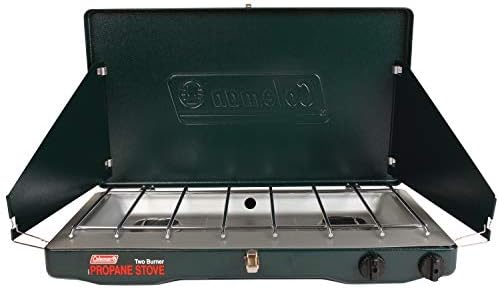
Check how the side guards latch. Some clip firmly and some rely on friction, and the friction ones fold down at the worst moment. This is a detail you can see clearly in listing photos and owner reviews, and it is worth two minutes of looking.
Simmer Control Separates Real Stoves
Simmer is where cheap stoves fail. A burner that only runs high scorches sauce, welds oatmeal to the pot and turns chili into a cleanup project. Good stoves have valves with enough travel to hold a low, stable flame without cutting out.
Look for burners with a wide adjustment range described in the listing and confirmed by owners, and check whether the two burners are independently controlled. A stove where one knob affects both is not really a two burner stove for cooking purposes.
Cooktop Size and What Fits
The specification that quietly ruins meals is cooktop width. Coleman lists its Cascade Classic as fitting a 12 inch and a 10 inch pan at the same time, which is the practical benchmark: one large skillet plus one pot. If a stove cannot manage that, you are cooking in sequence rather than in parallel.
Grate design matters too. Widely spaced grates let small pots wobble, and a grate that is not removable is far harder to clean after a boil over. Removable, chrome plated grates wash at home rather than needing a scrub at the site.
Two Burner Stoves by Situation
Most car campers want one of four things from a two burner stove. Match yours before comparing model numbers.
The All Round Family Stove
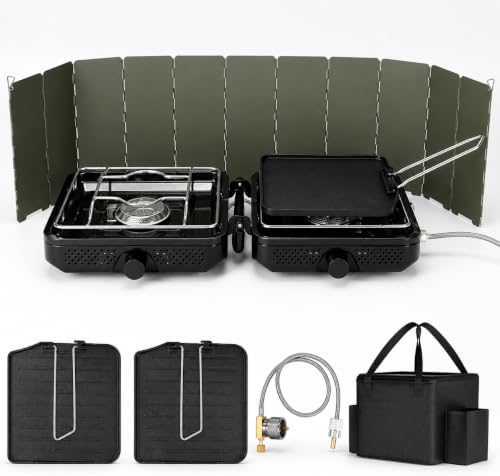
A classic steel two burner with fold up guards, an integrated igniter and removable grates handles the whole car camping season without asking questions.
Exposed Sites and Shoulder Seasons
A higher output stove with deep wind protection keeps a usable flame when the site is open and the mornings are cold, which is when weaker stoves start feeling slow.

Cooking on a Camp Kitchen Stand
Stoves designed to sit on a folding cook station stand free up the picnic table entirely and put the cooktop at working height instead of bench height.
Small Trunks and Two Person Trips
Compact two burner stoves trade cooktop width for pack size, which is the right call when the trunk is already full and you are only ever cooking two portions.

What to Compare on the Spec Sheet
Four specifications tell you most of what you need. Read them together rather than chasing the biggest single number.
| Specification | What it predicts | What to look for | Trap |
|---|---|---|---|
| Total BTU | Boil speed at full output | Match to pot size and season | Says nothing about simmer |
| Wind guards | Usable heat at a real site | Three sides plus a locking lid | Guards that fold under |
| Cooktop width | Whether two pans fit at once | A 12 inch pan plus a 10 inch pot | Measured to the outside edge |
| Burner control | Simmering without scorching | Independent knobs, wide range | One knob driving both burners |
Using a Two Burner Stove Safely
A propane two burner stove is an outdoor appliance. Coleman and Camp Chef state in their manuals that these stoves are for outdoor use only and must never be operated inside a tent, an awning, a screen room, a vehicle or any enclosed space, because burning propane produces carbon monoxide.
Use the clearances given in your own model’s manual rather than estimating, set the stove on a level surface where a tipped pot cannot reach anyone, and leak check the cylinder connection with soapy water when you fit a fresh one. Carrying a battery powered carbon monoxide alarm for the sleeping area is a cheap habit worth keeping.
Frequently Asked Questions
How many BTU do I need for a camp stove? Enough to boil a pot in a reasonable time for your group, which most two burner stoves in the common output range already do. Simmer control and wind protection change your cooking more than raw output.
Can a two burner stove replace a camp grill? Partly, especially with a griddle plate on top. What it cannot replicate is drippings hitting flame, which is what gives grilled food its flavor.
Do I need an igniter or are matches fine? An igniter is a convenience that occasionally fails, so carry a lighter regardless. Do not pay a large premium for one.
Will a two burner stove work in the wind? With proper three sided guards and sensible placement, yes. Without guards, output drops sharply and fuel use climbs.
Can I run a two burner stove off a large propane tank? Many models accept an adapter hose to a refillable tank. Check your specific model’s accessory list and follow the maker’s connection instructions.
How do I clean a camp stove after a boil over? Lift out the grates and drip tray if they are removable, scrape while warm, and finish the job at home. Scrubbing greasy water at a campground spigot puts it where it should not go.
The Bottom Line
A two burner camp stove is judged at the low end of the dial, not the high one. Buy for independent simmer control, guards that stay latched and a cooktop wide enough for a skillet and a pot together, and treat total BTU as a boil speed figure rather than a quality score. Our propane stove fuel guide works out how many cylinders a weekend needs, and the Coleman lineup compared untangles the model numbers.