Last updated: August 20, 2026
String lights are the piece of camp gear that gets mocked until somebody actually runs them. Strung along the edge of a canopy, they do something a lantern cannot: they light the whole site evenly and at a low level, so people can see the guylines, the cooler and the step down to the fire ring without anyone getting a beam in the face. They also mark the edge of your site, which quietly solves the problem of strangers cutting through it after dark.
The catch is that they run all evening, which makes power draw the deciding specification rather than an afterthought. A string that sips from a USB port is a different proposition from one that expects a wall outlet at a powered site. This guide covers the power options, how the strings pack down, and where to actually hang them so they light the site instead of the underside of the canopy.
This article contains affiliate links. If you buy through them, we may earn a commission at no extra cost to you. Learn more.
Quick Answer
Are string lights practical for camping?
- Yes, if you match the power source to your site: USB or battery for unpowered, mains only if you have a hookup.
- USB LED strings draw very little, so a modest power bank runs one for several evenings.
- Warm white attracts fewer insects and makes the site feel like a campsite rather than a display.
- Retractable or reel-based strings are the ones that survive being packed and unpacked repeatedly.
Bottom line: a warm white USB string on the canopy edge is the version that works on any site, powered or not.
Power Draw Is the Whole Decision
String lights run for four or five hours an evening, which is far longer than a lantern spends on its brightest setting. That makes continuous draw the specification that matters. Modern LED strings pull very little, but the difference between a USB string and a mains string decides whether the lights work on an unpowered site at all.
Three arrangements dominate. USB strings run from a power bank, a power station or a car port and suit almost every car camper. Battery strings take AA cells and need no infrastructure. Mains strings assume a powered site with an outlet and are the wrong purchase if you camp anywhere without a hookup.
Estimating Runtime Honestly
Manufacturers publish a wattage for the string, and dividing your battery’s watt hour rating by that figure gives a rough runtime before losses. Use the manufacturer’s published wattage rather than guessing from the number of bulbs, since LED efficiency varies enormously between strings. If the listing does not state a wattage or a current draw, treat that as a reason to look at a different string.
Warm White, Color and Bugs
Warm white is the right default for a campsite. It reads as firelight rather than as a shop window, it flatters food on the table, and warmer tones attract noticeably fewer flying insects than cold blue-white light. Color-changing strings look fun in the listing photos and get switched to a single warm setting by the second night.
Brightness matters less than you expect. String lights are background lighting, not task lighting, and a string bright enough to cook by will also be bright enough to annoy the site next door. Look for a string with a dimmer or at least a low setting, and keep the real work lit by a lantern over the table.
Camp String Lights by Situation
Best for Any Site, Powered or Not
A warm white LED string with a USB plug is the version that goes everywhere. It runs from a power bank in a pocket of the canopy, from the car during the day, or from a power station, and it packs down small enough to live permanently in the camp bin.

Best When You Want No Cables at All
Battery powered strings that take AA cells need nothing else in the kit, which makes them the simplest option for occasional campers and for lighting a tent porch away from where the power lives. Keep spare cells in the bin and accept a shorter runtime.

Best for Packing and Unpacking Every Trip
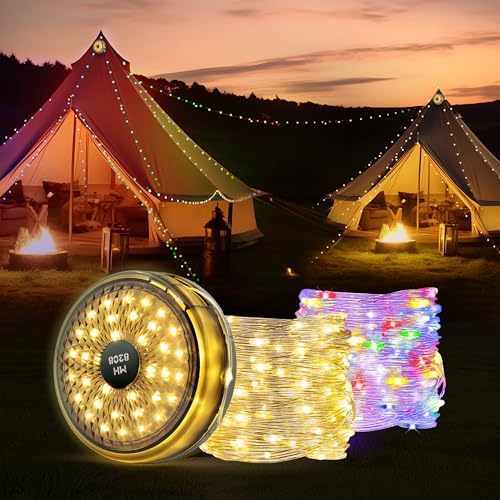
Loose strings tangle, and a tangled string gets left in the bin. Retractable models on a reel or a spool solve this properly, and campers who use string lights on every trip tend to end up with one of these regardless of what they started with.
Best for a Long Awning or a Group Site
Longer strings with heavier duty cable suit a big canopy, a shared group site, or an RV-style awning run. Check the length and the connector type on the listing, and check whether the string can be daisy chained before you buy two expecting to join them.

Comparing the Power Options
The power source decides where you can use the string and what you have to carry. This is the short version.
| Power source | What it needs | Typical runtime | Best for |
|---|---|---|---|
| USB | Power bank, power station or car port | Several evenings from a modest bank | Most car campers |
| AA batteries | Cells and spares in the bin | Shortest, varies by string | Occasional use, tent porch |
| Mains | Powered site with a hookup | Unlimited while plugged in | Full-service campgrounds only |
| Integrated solar | A day of direct sun on the panel | Depends on the day’s sun | Long stays on open sites |
Where to Actually Hang Them
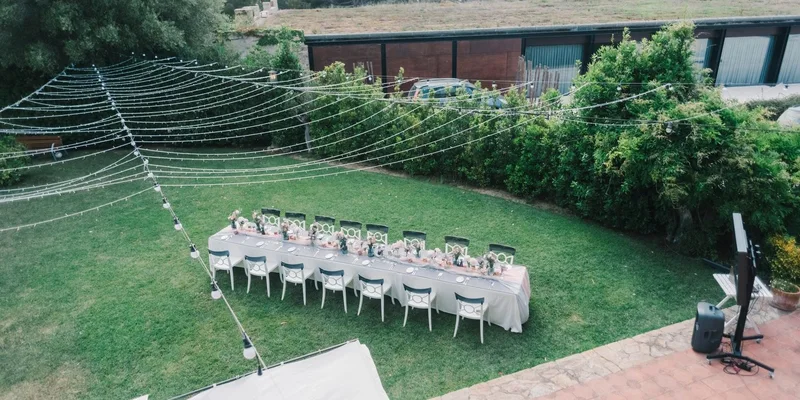
The most common mistake is running the string along the underside of a canopy roof, which lights the canopy and leaves the ground dark. Run it along the outer edge of the canopy instead, at roughly the height of the eave, so the light falls outward and downward across the site.
The second useful run is around the perimeter of the site itself, using the canopy legs, a nearby tree and a guyline as anchor points. That lights the trip hazards and makes the boundary of your pitch obvious to anybody walking past, which is the quiet reason string lights reduce the number of people cutting through your site after dark.
Anchoring Without Damaging Anything
Use the plastic clips supplied with the string, small carabiners, or short lengths of cord rather than tying the cable itself around a pole. Never nail, screw or tape anything to a tree, and check the campground rules before hanging anything from vegetation, since many parks and forests prohibit it entirely. On a windy site, secure the string at more points than feels necessary or it will spend the evening slapping the canopy.
Common Mistakes With Camp String Lights
The first mistake is buying a mains-powered string for a camper who mostly uses unpowered sites. It is a frustrating discovery to make at the site, and the listing does not always make the power requirement obvious. Check what plug is on the end before you order.
The second is leaving them on all night. String lights on until dawn drain the battery, irritate neighboring sites during quiet hours, and remove the darkness that is half the reason people camp. Switch them off when the group goes to bed, or buy a string with a timer function and set it.
Frequently Asked Questions
How much power do camping string lights use? Modern LED strings draw very little, and a USB string will typically run for several evenings off a modest power bank. Use the wattage published on the listing rather than estimating from the bulb count.
Can I run string lights off a portable power station? Yes, and it is one of the easiest loads a power station handles. A USB string is the most efficient option because it skips the inverter that a mains string would need.
Are string lights allowed at campgrounds? Usually, but rules vary and some parks restrict what can be hung from trees or ask that lights go off during quiet hours. Check the campground or the land manager’s rules for the site you are visiting.
Do string lights attract bugs? Any light does, but warm white attracts noticeably fewer flying insects than cold blue-white. Hanging the string at the edge of the site rather than directly over the table also helps.
Are string lights waterproof? Outdoor rated strings carry an IP rating, and that rating is the only reliable answer. Check it on the listing, and bring the string in if a serious storm is forecast rather than trusting a rating you have not verified.
How long a string should I buy? Measure the run you actually want to light, usually the perimeter of a canopy plus a little slack for anchoring. Buying one long string is simpler than joining two, since not all strings can be daisy chained.
The Bottom Line
String lights earn their place in the bin when they are warm white, USB powered, and hung along the outer edge of the canopy rather than under its roof. They are background light, not task light, so they work alongside a bright lantern rather than replacing one. Our camping lantern guide covers the task lighting half of the setup, and if the string will run off a battery, how many watt hours a weekend needs puts the draw in context. A camping canopy gives you something to hang the string from in the first place.