Last updated: August 20, 2026
Folding solar panels have become cheap enough that people buy one before working out what it is for. Then it spends the weekend leaning against a cooler in dappled shade, producing a trickle, and the owner concludes that camping solar does not work. The panel was probably fine. The problem is that solar output collapses with shade and with angle, and a campsite chosen for its trees is a bad place to put a panel.
Used properly, a portable panel changes what a trip can be. It turns a fixed battery budget into a daily allowance, which is the difference between a two-night trip and an open-ended one. This guide covers how many watts you actually need for camp loads, why the panel’s rating and what reaches your battery are two different numbers, and the one specification that catches people out completely.
This article contains affiliate links. If you buy through them, we may earn a commission at no extra cost to you. Learn more.
Quick Answer
How many watts of solar do you need for camping?
- Phones, lights and a fan: a small panel is plenty, and often a power bank alone is enough.
- A power station you want topped up each day: a 100 watt class folding panel is the usual starting point.
- A 12V fridge running continuously: expect to need more panel than feels reasonable, plus good sun.
- Check your power station’s maximum solar input before buying, because it caps what any panel can deliver.
Bottom line: match the panel to the battery’s published input limit and to the loads you actually run, then site it in full sun rather than beside the tent.
The Rating on the Panel Is a Laboratory Number
A panel’s watt rating is measured under standard test conditions: full, direct, perpendicular sunlight at a set temperature. A campsite delivers none of that reliably. Real output on a good day with the panel angled at the sun is a healthy fraction of the rating, and output in shade, haze or flat placement is far lower.
This is not a criticism of the panels, it is how solar is specified across the industry. Treat the rating as a comparison tool between panels rather than as a promise of what your battery will receive. Plan around a working figure well below the label and you will rarely be disappointed.
Angle and Shade Do the Damage
A panel lying flat on the ground receives far less than the same panel propped to face the sun, which is why folding panels come with adjustable kickstands. Partial shade is worse still: a branch shadow across part of the panel can cut output out of all proportion to the area it covers. Moving the panel twice during the day is the cheapest performance upgrade available.
Check Your Power Station’s Input Limit First
This is the specification that catches people out. Every power station has a maximum solar input, published by its manufacturer, and connecting a bigger panel does not push more energy in. Buy a large panel for a small power station and the surplus simply goes nowhere, which is a genuinely common and expensive mistake.
Look for the maximum input in watts and the accepted voltage range on the power station’s specification sheet, and match the panel to both. Connector type matters as well, since manufacturers use different plugs and some panels ship with an adapter set while others do not. Confirm both on the listing before ordering rather than after.
Portable Solar Panels by Situation
Best for Keeping a Power Station Topped Up
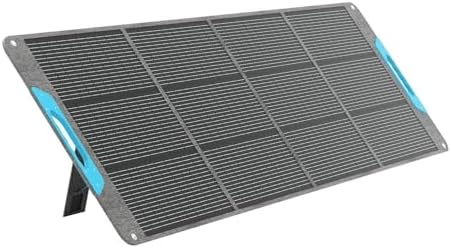
The 100 watt class folding panel is the mainstream choice for car camping, and it is what most mid-size power stations are designed to accept. It folds to about the size of a laptop bag, props itself up on integrated legs, and covers daily phone, light and fan use with margin.

Best When a Fridge Is on the Circuit
A compressor fridge runs day and night, and matching that with solar takes more panel than most people expect. Look at panels above the 100 watt class, and check that the power station’s input limit can actually accept them before you buy.

Best for Charging Phones and Small Devices Only
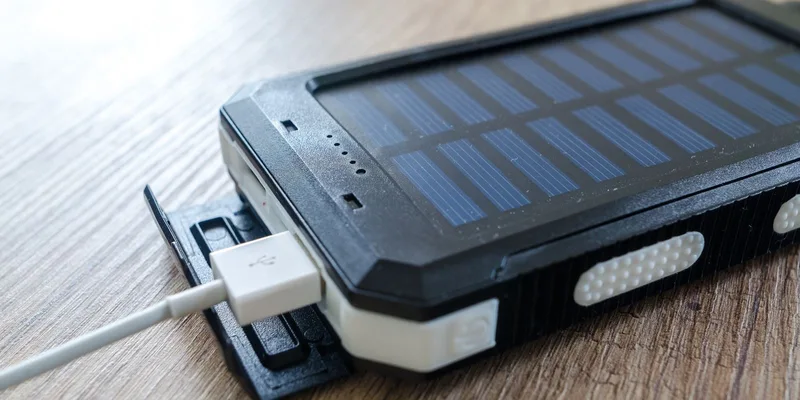
If nothing bigger than a phone, a headlamp and a lantern needs charging, a small panel with USB outputs skips the power station entirely. It is lighter, cheaper, and adequate for the way most weekend campers actually use electricity.

Best for Sites Where the Panel Must Be Left Out
Panels get rained on and stepped near. Outdoor rated models publish an IP rating covering water resistance, which is what to compare rather than a marketing claim about weather resistance. Fold it away in a real storm regardless.
Matching Panel Size to Camp Loads
Loads at a campsite fall into three groups, and the gap between them is enormous. Devices and lights are trivial, a fan is modest, and a fridge is in a category of its own. Size the panel around the biggest continuous load rather than the total number of items.
| What you run | Panel class | Realistic expectation | Also needed |
|---|---|---|---|
| Phones and headlamps | Small USB panel | Comfortably covered on a sunny day | Nothing, or a small power bank |
| Lights, fan, devices | 100 watt class | Tops up a mid-size battery daily | Power station with matching input |
| 12V fridge plus the above | Above 100 watt class | Depends heavily on sun and duty cycle | Larger battery as a buffer |
| Shaded forest site | Any | Low output, plan on battery capacity | Charge from the car instead |
Siting the Panel at a Real Campsite
The best spot for a panel is almost never next to the tent. It is wherever the sun actually falls, which at a wooded campground often means the parking pad, the edge of the site, or the roof of the car. Bring a long extension cable so the panel can sit in the sun while the battery stays in the shade where it belongs.
Batteries dislike heat, so keeping the power station cool while the panel bakes is a genuine benefit rather than a detail. Weight the panel down or peg it if there is any wind, since a folding panel is essentially a sail, and check on it when you move around the site so a shadow has not crept across it.
Security and Common Sense
A panel left in the open on an unattended site is visible and portable. Take it in when you leave for the day at a busy campground, or at least move it out of sight from the road. Nothing about solar changes the ordinary rules of not leaving valuables out at a public site.
Frequently Asked Questions
How many watts of solar do I need for camping? A 100 watt class folding panel suits most car campers topping up a mid-size power station. Charging only phones needs far less, and running a 12V fridge continuously needs more.
Why is my solar panel producing less than its rating? Ratings are measured under standard laboratory test conditions. Angle, haze, temperature and especially partial shade all reduce real output, and shade reduces it out of proportion to the area covered.
Can any solar panel charge any power station? No. Every power station publishes a maximum solar input in watts and an accepted voltage range, and connectors differ between brands. Match the panel to those published figures before buying.
Will a solar panel charge a power station in one day? Sometimes, on an open site with good sun and a correctly angled panel. On a shaded forest site, plan on the battery you brought and treat solar as a supplement.
Are folding panels or rigid panels better for camping? Folding panels win for car camping because they pack flat, stand themselves up and move easily to follow the sun. Rigid panels suit permanent installations, which is a different job.
Can I leave a solar panel out in the rain? Check the IP rating the manufacturer publishes. Outdoor rated panels handle ordinary weather, but fold and store the panel in a serious storm, and keep the connectors dry.
The Bottom Line
Buy the panel around two numbers: your power station’s published maximum solar input, and the size of your biggest continuous load. A 100 watt class folding panel covers most car camping electricity, a fridge needs more, and phones alone need far less. Then site it for sun rather than for convenience. For the arithmetic behind those loads, see how many watt hours a weekend needs, and if the fridge is the reason you are here, sizing a power station for a camp fridge covers the duty cycle question in detail.