Last updated: August 20, 2026
Cot or air mattress is the question that decides how the rest of a car camping sleep system gets built, and the answer people expect is usually the wrong way round. Most campers assume the cot is the warmer option because it lifts you off cold ground. In practice both of them sleep cold for the same reason, and the difference between them is not warmth at all until you add a pad.
What actually separates them is how they fail. A cot gives you a firm, permanently level surface that never deflates and takes up a fixed footprint. An air mattress gives you a wide, contoured surface that softens overnight and can lose air entirely if something punctures it. This comparison works through both honestly, then points you to the one that matches your tent, your trips and your back.
This article contains affiliate links. If you buy through them, we may earn a commission at no extra cost to you. Learn more.
Quick Answer
Which sleeps warmer, a camping cot or an air mattress?
- Neither, on its own. Both put moving air under you, and both need a pad on top to sleep warm.
- The cot wins on level ground, wet sites, storage underneath and never going flat.
- The air mattress wins on width, on softness for side sleepers, and on packed size.
- With a pad added, the cot is generally the more consistent option in cold weather.
Bottom line: choose the cot for rough or wet sites and reliability, the air mattress for width and comfort, and add a pad either way.
The Warmth Question, Answered Properly
Both options put a layer of air between you and the cold, and air moves. Under a cot the air circulates freely around the frame. Inside an air mattress the air is trapped but it convects, warming near your body, rising, cooling at the base and sinking again, which quietly moves your heat toward the ground all night.
That is why campers who put a foam or self inflating pad on top of either one report a completely different night. The pad, not the platform, is what stops downward heat loss, and our guide to sleeping pads for camping covers how the R value figure describes exactly that.
Where the Cot Wins
A cot gives a level surface regardless of what is underneath it, which matters on a rocky pad or a site that slopes. It stays at the same height and firmness from the first night to the last, it keeps you above water running under the tent floor in heavy rain, and it turns the space beneath into storage in a crowded tent.
It is also the easier option for anyone who finds getting up off the floor difficult, since the deck sits at closer to chair height. The costs are a fixed rigid footprint that has to fit your tent, a heavier folded package, and legs that press hard on a tent floor.
Where the Air Mattress Wins
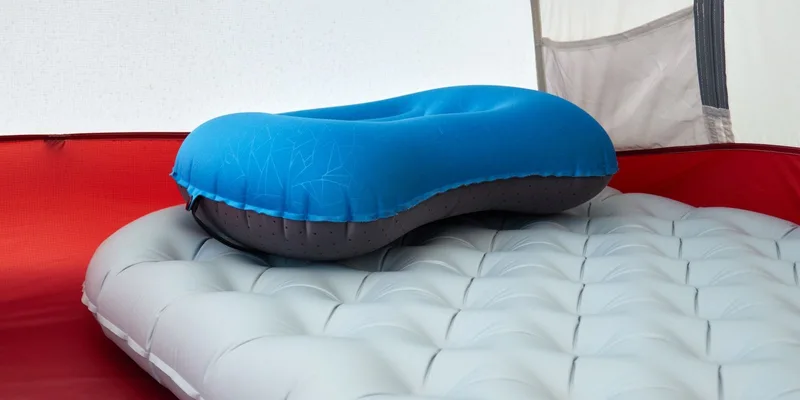
An air mattress gives more sleeping surface for the space it occupies, contours around a shoulder and a hip instead of holding you flat, and packs down to a fraction of a cot’s folded size. For couples and families it is usually the cheaper way to get a wide shared bed into a tent.
The tradeoffs are real. Air pressure drops as the tent cools overnight, so a mattress inflated firm at dusk feels soft by morning, and a puncture from a stray twig ends the night rather than merely annoying you. Our guide to a camping air mattress covers which constructions hold up.
Why an Air Mattress Feels Softer by Morning
Air contracts as it cools. That is ordinary physics rather than a leak, and it explains why an evening top up is a normal part of using one rather than a sign the mattress has failed. Campers who assume a slow leak often find the mattress holds pressure fine at a stable temperature.
Test for an actual leak at home, inflated, over a couple of days at room temperature. That separates a real puncture from the overnight cooling effect and saves an unnecessary return.
Side by Side
| Factor | Camping cot | Air mattress | Deciding point |
|---|---|---|---|
| Warmth alone | Cold, air underneath | Cold, air convects inside | Both need a pad |
| Firmness overnight | Constant | Softens as it cools | Cot for consistency |
| Ground conditions | Level on any surface | Follows the ground | Cot on rocky sites |
| Packed size | Long, heavy bag | Small, plus a pump | Mattress for tight trunks |
Which One Suits Which Camper
Choose a cot if
Your sites are rocky, sloped or prone to standing water, you camp in shoulder season, you want storage under the bed, or getting up off the floor is uncomfortable. A cot also suits campers who dislike the idea of a night depending on a seal holding.

Choose an air mattress if
You need a wide shared bed, you camp mostly in warm weather, your trunk is full, or you sleep on your side and want contour rather than a taut deck.

Choose the pad either way
Whichever platform you pick, a self inflating pad on top is what turns it into a bed that holds warmth. This is the single upgrade that changes the most nights per dollar spent.

Common Mistakes
The first mistake is buying a cot expecting it to solve cold, then concluding cots are uncomfortable. The second is inflating an air mattress rock hard on a warm evening, which leaves it firm at bedtime and, once the air cools and contracts, noticeably softer than you wanted by early morning.
The third is buying either one without measuring the tent floor. A cot has to fit rigidly and an air mattress has to fit without pressing its sides against the inner wall, which is where condensation transfers onto bedding.
Frequently Asked Questions
Is a cot warmer than an air mattress? Not inherently. Both lose heat downward, a cot through open air under the deck and an air mattress through convection inside it. A pad on top is what makes either one warm.
Which is more comfortable for a bad back? That is individual, and persistent back pain is worth raising with a clinician rather than solving by gear alone. Campers generally report a cot with a thick pad gives firmer, more even support. See our pad guide for a bad back.
Can I put an air mattress on a cot? It usually overhangs the deck, raises the center of gravity and adds weight against the cot’s published capacity. A wide self inflating pad is the better match.
Which lasts longer? A steel cot has no seal to fail, while an air mattress depends on seams and a valve. Cots generally last longer with rough handling, though a well cared for mattress can serve for years.
Which is better for a family tent? Air mattresses usually pack more sleeping area into a shared floor, and they let kids sleep next to each other. Cots keep gear storage available underneath.
Do I still need a sleeping bag rated for the conditions? Yes. The platform and pad handle heat loss downward; the bag handles everything else.
The Bottom Line
The honest comparison is not warm versus cold, it is consistent versus contoured. A cot gives a level, firm, reliable surface on any site and needs a pad to be warm. An air mattress gives width and softness in a smaller package and also needs a pad to be warm. Pick the platform that matches your sites and your tent, then spend the next dollar on what goes on top. Read our camping cot guide and our camping air mattress guide for the specifics.