Last updated: August 20, 2026
Anyone who has tried to sleep in a tent in July already knows the problem. The sun hits the fly at six in the morning, the inside temperature climbs faster than the air outside, and by seven nobody is sleeping. A fan helps until it stops helping, which is roughly the point where the air itself is the problem.
Portable air conditioning for tents is now a real category rather than a novelty, but it comes with hard constraints that the listings do not lead with. An air conditioner has to put hot air somewhere, it draws serious power, and a tent is not a room. This guide covers what actually cools a tent, what each option costs you in power and packing, and when a fan is still the better buy.
This article contains affiliate links. If you buy through them, we may earn a commission at no extra cost to you. Learn more.
Quick Answer
Does a portable AC actually cool a tent?
- A true compressor air conditioner does, provided its hot exhaust is ducted outside the tent through a port or a sealed opening.
- Power is the real constraint. Compressor units want shore power or a large battery, and runtime is measured in hours rather than nights.
- Evaporative coolers work in dry climates only, and add humidity that makes a humid night worse.
- In a shaded, breezy site, a good fan does more per dollar and per watt than any air conditioner.
Bottom line: sort out exhaust and power first, because those two decide whether cooling is possible at your site at all.
How Tent Cooling Actually Works
An air conditioner does not create cold, it moves heat from one side of a coil to the other. That means every compressor unit produces a stream of hot air that has to leave the tent, through a duct in a purpose built AC port or a sealed opening you create. Run one inside a closed tent with the exhaust indoors and you will make the tent hotter, not cooler.
Evaporative coolers work on a different principle, pulling air across a wet medium so evaporation absorbs heat. They need no exhaust and draw a fraction of the power, which sounds ideal until you notice the condition attached. They only work where the air is dry, and they add moisture, so in a humid climate they trade a few degrees for a clammy tent.
The Power Problem, in Numbers
Compressor cooling is the single most demanding thing most campers ask a battery to do. Manufacturers publish the draw for each unit, and the arithmetic is simple: divide your power station’s watt-hour capacity by the unit’s running watts to get an approximate runtime. That division answers the question faster than any review.
What the Manufacturers Publish
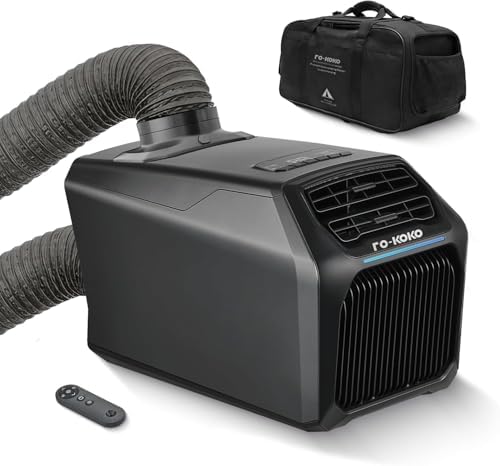
EcoFlow describes its Wave 3 at 6,100 BTU, weighing 33.7 pounds, with no built in battery, and lists a sleep mode running at 44 decibels. Zero Breeze lists the Mark 3 at 5,280 BTU and 22 pounds. BougeRV lists a 2,899 BTU unit at 250 watts on 24 volt DC. Those published figures are what to compare, rather than category generalizations.
Shore Power Changes Everything
At a campground with an electrical pedestal, the power question disappears and the exhaust question remains. Check what the campground permits you to draw, use an outdoor rated cord, and route it where nobody trips over it in the dark. Many campgrounds cap what a tent site may pull, so ask before you plan around it.
Options by Camping Situation
Your site decides more than the product does. Off grid in the desert is a different problem from a humid state park with hookups, and the honest answer for some sites is a fan and better shade. Here is how the situations sort out.
Off Grid, Where Nothing Is Plugged In
A unit designed to run from a battery, either integrated or as a matched add on, is the only compressor option that works at a dispersed site. Expect to carry real weight and to plan the night around published runtime rather than assuming it lasts until morning.

Vehicle Based Cooling
Low power DC units are built to run from a 12 or 24 volt supply, which suits campers already carrying a house battery or a large power station. Output is modest compared to a household air conditioner, and it is sized for a sleeping space rather than a cabin tent full of people.

Campground With a Pedestal
With shore power, a compact household style portable air conditioner becomes viable, provided you can duct the exhaust out of the tent and the campground allows the draw. This is by far the cheapest route to real cooling if your camping happens at developed sites.
Dry Heat, Low Power
In the desert Southwest and other genuinely dry climates, an evaporative cooler delivers a noticeable drop for a small fraction of the power and weight. In humid regions it is the wrong tool, and no amount of fan speed changes that.

Getting the Exhaust Out
Tents without a dedicated AC port need a way to pass a duct through the wall without leaving a gap that lets hot air straight back in. Duct kits and sealing panels handle this, and our guide to fitting an AC to a tent without a port walks through the options in detail.

Comparing the Approaches
The table sets the three cooling approaches against the constraints that decide which one you can actually use. Read the power column first, because it eliminates more options than anything else.
| Approach | Power appetite | Needs exhaust | Where it works |
|---|---|---|---|
| Compressor AC | High, hours per kilowatt-hour | Yes, ducted outside | Anywhere, if power and a port exist |
| Low power DC unit | Moderate, sized for a house battery | Yes, ducted outside | Vehicle based camping |
| Evaporative cooler | Low, similar to a fan | No | Dry climates only |
| Fan and shade | Very low | No | Almost everywhere, as a first step |
Do the Free Things First
Before spending on cooling, spend an hour on siting. Pitch where afternoon shade falls rather than where the morning sun looks pleasant, orient the door into the prevailing breeze, and get the fly off the inner tent wherever the design allows so hot air can escape upward instead of pooling.
A reflective tarp rigged above the tent, with a gap for air to move between tarp and fly, does more than most people expect, because it stops radiant heat before it reaches the fabric. Add a good fan on top of that and many campers find the air conditioner unnecessary, which is the argument our camping fan guide makes in more detail.
Frequently Asked Questions
Can you run a portable AC in a tent without a port? Only if you create a sealed opening for the exhaust duct, because the hot air has to leave. Passing the duct through a partly unzipped door without sealing around it lets the heat straight back in.
How long will a power station run a tent air conditioner? Divide the station’s watt-hour capacity by the unit’s published running watts. Expect a few hours per kilowatt-hour on a compressor unit, not a full night, unless the manufacturer publishes otherwise for that combination.
Are evaporative coolers worth it for camping? In dry climates, yes, for very little power. In humid regions they add moisture and deliver little cooling, so a fan is the better purchase there.
What size air conditioner does a tent need? Compare the published BTU rating against your tent size and how well you can seal it, remembering that a tent leaks heat far faster than a room. Manufacturers publish coverage guidance per model, and that is the figure to use.
Is a tent air conditioner loud? Compressor units make real noise, though several publish a quieter sleep mode, and EcoFlow lists 44 decibels for the Wave 3 in that mode. Check the published figure for the model you are considering.
Would a fan be enough instead? Often, especially in a shaded site with a breeze. A fan moves air across your skin rather than lowering the air temperature, and for many campers that is the difference between sleeping and not.
The Bottom Line
Real tent cooling needs two things solved before you shop: somewhere for the hot exhaust to go, and enough power to run a compressor for the hours you need. Fix shade and airflow first, then choose a compressor unit if you have shore power or a large battery, an evaporative cooler only in a dry climate, and a fan if neither applies. Read next: fitting an AC to a tent without a port and our rechargeable tent fan guide.