
Last updated: August 20, 2026
Cooler capacity is quoted in quarts, which tells you almost nothing useful until you know how much of that volume disappears under ice. People plan meals for four, add up the groceries, buy a cooler that fits exactly that, and then find there is no room left for the bag of ice that keeps any of it cold.
The sizing question also gets answered wrong in the other direction. A cooler big enough to swallow everything is a cooler that runs half empty, burns through ice faster, and takes two people to move once it is loaded. This guide works through the arithmetic for a family weekend and lands on a setup rather than a single number.
This article contains affiliate links. If you buy through them, we may earn a commission at no extra cost to you. Learn more.
Quick Answer
What size cooler does a family of four need?
- Plan on a large share of the internal volume going to ice, not food.
- A mid sized hard cooler for food plus a smaller one for drinks beats one huge box.
- Two coolers you can each lift alone beat one you cannot move without help.
- Check the quart figure in the listing, since external size varies a lot for the same capacity.
Bottom line: size for food plus ice, split food and drinks into two coolers, and keep each one light enough for one person to carry.
Start With Ice, Not Groceries
The usual packing guidance for a hard cooler is roughly two parts ice to one part contents by volume, which means the majority of a cooler’s quoted capacity is not available for food. Any sizing calculation that starts from the grocery list and stops there will come up short by a wide margin.
That ratio moves with conditions. A shorter trip in mild weather needs less, a hot weekend with a cooler that gets opened constantly needs more. Plan generously and use the surplus as a buffer, because a cooler packed tight with ice holds cold much better than one with gaps.
The Two Cooler Split for a Family
Split by how often something gets opened. Food goes in a cooler that opens twice a day at meal times, drinks and snacks go in a second one that gets opened by children roughly every eleven minutes. Every lid lift dumps cold air, and separating the traffic is the cheapest way to extend ice life.
The practical bonus is that two mid sized coolers are easier to load than one large one. They fit into different gaps in a packed trunk, either adult can carry one, and if the drinks cooler runs out of ice on Sunday, the food is unaffected.
How Big Each One Should Be
The food cooler is the one to size properly, because it carries the perishables and needs to stay cold for the whole trip. The drinks cooler can be smaller, or a soft cooler, since drinks tolerate warming and get consumed rather than stored.
If you already own one large cooler, adding a soft cooler for drinks fixes most of the problem without a second big purchase. That is usually the cheapest upgrade available to a family camping setup.
Working Out the Number for Your Trip
Count nights first, then meals, then the drinks. Two nights for four people means breakfast twice, dinner twice, lunches, and whatever the children eat between all of it. Lay it out on the kitchen counter before the trip and you get a much better estimate than any online calculator, because it accounts for how your family actually eats.
Then add the ice. Whatever pile is on the counter, plan for the cooler to be roughly twice that volume once ice fills the spaces around it. That is the number to shop against.
Listings Publish Can Counts for a Reason
Most coolers list a can capacity alongside the quart figure, which is a useful sanity check because it tells you how the maker expects the interior to be filled. Read it as a maximum with no ice at all rather than a realistic loadout.
External dimensions are the other listing figure worth reading. Two coolers with identical quart capacity can differ enormously on the outside, because thick rotomolded walls take space that a standard cooler puts to work.
Cooler Setups for Different Family Trips
| Trip | Food cooler | Drinks cooler | Watch out for |
|---|---|---|---|
| One night, four people | Small to mid hard cooler | Soft cooler | Overbuying for a single night |
| Two nights, four people | Mid sized hard cooler | Soft or small hard cooler | Leaving no space for ice |
| Long weekend, family plus guests | Large hard cooler, kept shut | Separate hard cooler | Weight when fully loaded |
| Several days, no store nearby | Rotomolded, food only | Standard cooler for drinks | Two person lift, trunk fit |
What to Buy for a Family Weekend
The Food Cooler
A mid sized hard cooler with solid insulation and a lid that seals properly is the piece that carries the trip. Coleman’s Xtreme line sits in exactly this space for family camping: enough capacity for meals plus ice, without becoming something two adults have to lift together.

The Upgrade for Longer Stays
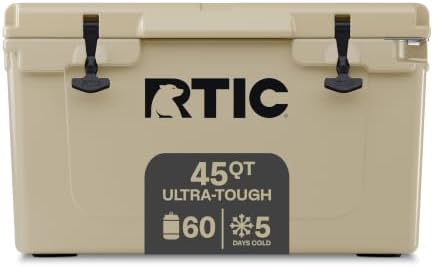
If your trips run past a weekend or the campground has no store, a rotomolded cooler holds the food side of the split for far longer. RTIC builds this construction with thick walls, a freezer style gasket and heavy latches at a lower price than the premium names.
The Drinks Cooler That Takes the Abuse
A soft cooler on drinks duty absorbs all the lid opening and carries to the beach or the picnic table on a shoulder strap. It also folds flat for the drive home, which is why it is the easiest second cooler to justify.

Loading a Family Cooler So the Size Works
Pack in reverse order of use, with the last day’s food at the bottom and breakfast on top. Block ice underneath, contents in the middle, cubed ice filling every gap. A cooler sized correctly but packed loosely will still lose its ice early, because air space is what melts ice.
Keep raw meat sealed and at the bottom where the coldest meltwater sits, and keep anything you want dry in sealed containers rather than trusting the drain. USDA’s Food Safety and Inspection Service lists 40 degrees Fahrenheit or below as the safe holding temperature for cold perishable food, so an appliance thermometer in the food cooler is a useful thing to pack.
Where It Sits at the Site
Shade, off the ground if possible, and out of the traffic path. A cooler standing in afternoon sun on gravel is fighting heat from above and below, and moving it four feet under a tree is the most effective free upgrade available to any cooler of any size.
FSIS advises packing coolers with plenty of ice or frozen gel packs and keeping them in the shade where possible, which is the same advice that makes a smaller cooler perform like a bigger one.
Frequently Asked Questions
What size cooler do I need for a family of four for a weekend? Size for food plus roughly twice that volume in ice, then split drinks into a second cooler. In practice that lands most families on a mid sized hard cooler for food and a soft cooler for drinks rather than one very large box.
How many quarts is enough for four people? There is no single number, because it depends on nights, meals and how much of the food is frozen at the start. Lay the food out at home, double the volume for ice, and shop against that figure rather than a generic quart recommendation.
Is one big cooler or two smaller ones better? Two, in almost every case. Separating food from drinks keeps the food cooler shut, both are light enough for one person, and they pack into a trunk in places one large box will not fit.
How much ice do I need for a cooler? The common packing guideline is about two parts ice to one part contents by volume, more in hot weather and for longer trips. Fill every gap rather than leaving air space, since air is what melts the rest of the ice.
Does a bigger cooler keep ice longer? Only if it stays full. A large cooler running half empty performs worse than a smaller one packed tight, because the air inside warms every time the lid opens and the ice pays for it.
Should I buy a cooler I cannot lift alone? Think hard about it. Coolers get carried to the pad, back to the car and up steps, often when everyone is tired. If the loaded weight needs two people every time, that shapes every trip more than a couple of extra ice days do.
The Bottom Line
Size the food cooler for food plus roughly twice that in ice, put drinks in a second cooler, and keep each one liftable by one adult. That setup beats a single oversized box on ice life, on packing and on your back. Our cooler packing guide covers the loading order that makes the size work, and the main cooler guide covers choosing between standard and rotomolded construction.