Last updated: August 20, 2026
Open a camping utensil set at the site and you often find the same thing: a folded nylon roll containing a spatula, a ladle, tongs, a slotted spoon, a whisk, a pasta server, a corkscrew and a set of tiny cutting tools. Three of those get used every trip. The rest are weight, and one of them is a knife too short and too dull to cut an onion.
This guide covers what a camp kitchen actually needs from a utensil set, which pieces matter enough to buy well, and how the roll or case format decides whether the set stays organized after the third trip.
This article contains affiliate links. If you buy through them, we may earn a commission at no extra cost to you. Learn more.
Quick Answer
What do you actually need in a camping utensil set?
- A real chef style knife with a sheath, a spatula, tongs and a serving spoon cover almost every camp meal.
- A cutting board that is rigid enough to chop on, not a flexible mat.
- A case or roll that closes properly, so the set stays complete instead of migrating around the trunk.
- Silicone or nylon heads if you cook on non stick, metal if you cook on cast iron or a griddle.
Bottom line: four good tools in a case that closes beat a fourteen piece roll where the knife cannot cut.
The Four Tools That Earn Their Place
Almost every camp meal runs on a knife, a spatula, tongs and a serving spoon. The knife handles prep, the spatula turns everything on a griddle or in a pan, the tongs move food on a grate without stabbing it, and the spoon serves and stirs. Everything beyond those four is situational.
That is why piece count is a poor way to choose a set. A twelve piece roll with a weak knife is worse in practice than a four piece kit where each tool is properly made, because the knife is the one you use before every single meal.
The Knife Is the Whole Argument
Camp utensil sets routinely include a short, thin blade that struggles with an onion and terrifies anyone holding it. If the set you like has a poor knife, buy a proper chef style knife with a blade guard separately and treat the set’s knife as a spare. A sheath is not optional in a box full of loose metal.
Materials and What You Cook On
Match the utensil head to the surface. Metal spatulas and scrapers are what a steel griddle or a cast iron skillet wants, because they scrape residue and get under a crust. On a non stick pan they take the coating off, and the damage does not show until food starts sticking two trips later.
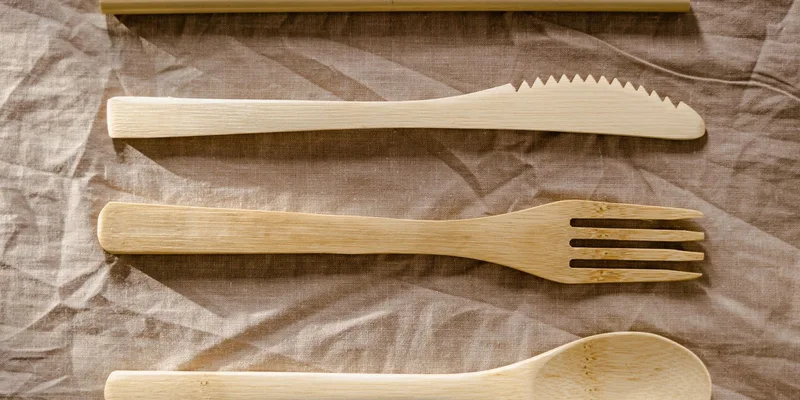
Silicone and nylon are the safe default if your cookware is coated, and they handle heat well enough for camp use. Wooden tools are pleasant but they absorb odors and take a long time to dry properly in a damp box, which is why most camp sets skip them.
Handles and Hanging
Long handles keep hands away from a hot griddle and a fire ring, and a hanging loop or hole means tools can live on a hook at the camp kitchen instead of on a table. Small detail, noticeable difference once you are cooking for a group.
Roll, Case or Loose in the Box
The container decides whether the set survives. A zip case or a roll with elastic loops keeps every tool in a known position, which is the same logic that makes a chuck box work. Sets that ship loose in a bag are complete for about two trips.
Hard cases protect blades and keep everything dry, but they are bulkier. Fabric rolls pack into gaps and weigh less, but they soak up water if they get wet and take a while to dry. If your kitchen lives in a chuck box, a roll is usually the better fit; if it lives in a bin, a hard case survives better.
Utensil Sets by Situation
What you need depends on how you cook, not on how many people you feed.
The Standard Family Camp Kitchen
A compact set with a knife, spatula, tongs and serving spoon in a closing case covers the meals a family actually cooks at a site.

Cooking on a Griddle or Cast Iron
Metal spatulas, a scraper and long handled tongs are what a flat top and a skillet need, and they are the tools a general set usually lacks.

Prep Space and a Real Blade
A rigid cutting board paired with a sheathed chef style knife turns a picnic table into a usable prep station, which no folding multi tool can do.

Starting a Kitchen From Nothing
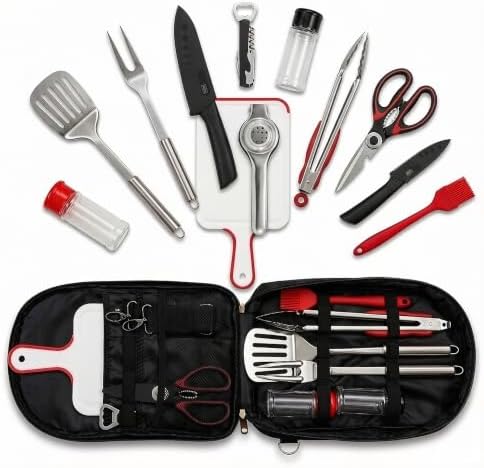
Larger organizer sets bundle utensils with a case, a board and cleaning tools, which is a reasonable way to fill a chuck box in one purchase.
What to Look For
Four things separate a set you keep from a set you replace.
| Feature | Why it matters | Good sign | Warning sign |
|---|---|---|---|
| Knife quality | Used before every meal | Full size blade with a sheath | Short, thin, no guard |
| Head material | Protects your cookware | Matches your pans | Metal sold for non stick use |
| Case | Keeps the set complete | Elastic loops, closes fully | Loose in a drawstring bag |
| Handle length | Distance from heat | Long, with a hanging loop | Short kitchen style handles |
Keeping the Set Complete
The reason camp utensil sets go missing is that they get used and then put down. Assign the set a permanent home in the chuck box or bin, count the tools back into the case before you strike camp, and keep the whole thing out of the house kitchen where pieces get absorbed.
Duplicating the cheap consumables helps as well. A second spatula and an extra set of tongs cost little and mean the kit is never short because one is soaking in the wash tub while dinner is going.
Washing and Drying
Wash utensils in the same two tub system as your cookware, scrape into the trash first, and let everything dry fully before it goes back in the case. Metal packed away damp rusts, and a fabric roll packed damp stays damp until the next trip.
Frequently Asked Questions
How many pieces should a camping utensil set have? Four good tools cover almost everything: a knife, a spatula, tongs and a serving spoon. Larger sets add convenience, not capability.
Can I use metal utensils on a camp griddle? Yes, a steel griddle and cast iron both want metal. Keep metal away from non stick coated pans, where it removes the coating.
Do I need a special camping knife? You need a proper full size kitchen knife with a sheath or blade guard. A pocket knife or a folding multi tool is not a prep knife.
Is a plastic cutting board good enough? A rigid plastic board is ideal for camp because it cleans easily and does not absorb odors. Flexible mats slide around and flex under a knife.
How do I keep utensils from getting lost at camp? Give the set one permanent home in your kitchen box and count the tools back into the case before you pack up the site.
Should the utensil set live in the chuck box year round? Yes. Anything borrowed from the house kitchen is something that gets forgotten, so keep a dedicated camp set and leave it packed.
The Bottom Line
A camping utensil set is judged on its knife, its case and whether the heads suit your cookware. Buy four good tools rather than fourteen mediocre ones, keep them in something that closes, and leave the set living in your kitchen box between trips. Our camping cookware set guide covers the pots these tools work with, and the chuck box guide covers where the whole kitchen lives.