
Last updated: August 20, 2026
Most camping cots are built around an assumed sleeper who is average height and average weight, and the listings rarely say so out loud. If you are heavier than that assumption, the first sign is not a dramatic failure, it is a deck that touches the ground when you sit on the edge, a leg that splays outward, or a creak on every turn that keeps you awake more effectively than the cold ever did.
The good news is that this is one of the few camping problems solved cleanly by published numbers. Manufacturers state a maximum supported weight for each cot and each size within a line, and the heavy duty category is a real category with real frames behind it. This guide covers how to read those numbers, what a genuinely reinforced frame looks like, and what else has to change when you size up.
This article contains affiliate links. If you buy through them, we may earn a commission at no extra cost to you. Learn more.
Quick Answer
Which camping cot holds up for a heavier adult?
- Buy by the published capacity for that exact model and size, not by the brand’s reputation.
- Leave margin above your body weight, because sitting on the edge loads the frame harder than lying down.
- Look for steel tubing, more legs, and a wider deck rather than a longer one alone.
- Oversized cots need a large, square tent floor, so measure the tent before ordering.
Bottom line: pick a steel oversized frame whose listed capacity sits comfortably above your weight, then check that it fits your tent and your trunk.
What the Published Capacity Actually Covers
The maximum supported weight in a cot listing is the total static load the manufacturer states the frame will carry. That includes you, your bedding, the pad on top, and anything you set down on the deck, which is why treating it as a personal weight limit understates the load you actually put on the frame.
Capacities vary widely inside the same brand. Teton, for instance, lists its Outfitter XXL at 600 pounds while its narrower cots carry lower figures, so the number belongs to the model and size rather than the maker. Read the specification block on the exact listing you are buying from.
Why Edge Loading Matters More Than Sleeping Weight
Lying down spreads your weight across the whole deck. Sitting on the rail to pull boots on concentrates most of it on one side rail and the two legs nearest that spot, which is the moment cots bend, splay or tip. That is the load case to buy for.
Practical margin is the answer rather than a formula. Choosing a frame rated well above your weight means the edge load stays inside what the frame was designed for, and it also means the cot still works if a second person sits down next to you while you are both getting organized in the morning.
Frame Details That Signal a Real Heavy Duty Cot
Look for steel tubing rather than thin aluminum, a higher leg count so the span between supports is shorter, and feet that are broad rather than pointed. Wide feet spread load on soft ground and are far kinder to a tent floor, which becomes more important as the load goes up.
Deck fabric matters too. Heavier cots typically use a denser polyester or a canvas style fabric with reinforced stitching along the rail sleeves, because the seam along the rail is where a stretched deck gives way first. A doubled or bar tacked seam is a better signal than a marketing phrase.
Size Up in Width, Not Only Length
Oversized cots are usually sold as longer and wider, and the width is the part that changes the night. A wider deck lets your arms rest on fabric instead of hanging over a steel rail, and it gives room to turn without feeling like you are balancing.
Extra width has a cost in the tent. Measure the tent floor where the cot will sit, not at the widest point of the fly, and remember that dome walls curve inward. Cabin style tents with near vertical walls are the easiest match for a wide cot.
Heavy Duty Cots by Situation
Best for maximum published capacity
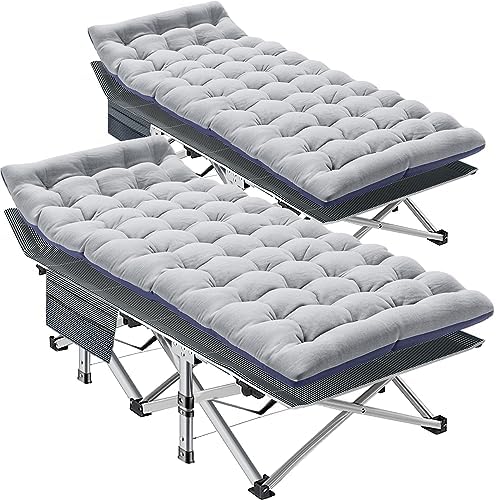
Oversized steel frames sit at the top of the category, with the widest decks and the highest stated limits. This is the right shelf to shop from if you want clear margin rather than a number that barely clears your weight.
Best for a tall camper who also needs capacity
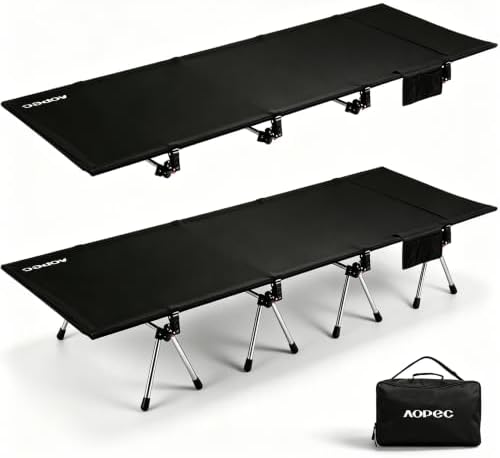
Extra long cots keep your heels on the deck instead of on the end rail, which is a comfort problem heavy duty models solve at the same time as the load problem.
Best when the tent is a standard size
Not every reinforced cot is oversized. Some standard footprint models publish higher capacities with a stronger frame, which suits campers whose tent floor will not take an XXL deck.

Best pad to go on top
A wide self inflating pad matters more on a heavy duty cot, because a narrow pad on a wide deck leaves cold fabric under your shoulders and hips exactly where you need support.

What Changes When You Size Up
| Aspect | Standard cot | Heavy duty cot | Why it matters |
|---|---|---|---|
| Frame | Lighter tubing | Steel, more legs | Shorter unsupported spans |
| Deck width | Narrow | Wider | Arms stay off the rail |
| Folded weight | Easy to carry | Noticeably heavier | Plan the trunk and the walk |
| Tent fit | Fits most floors | Needs a square floor | Measure before ordering |
Common Mistakes
The most common mistake is comparing your weight to the capacity and stopping there. Add the pad, the bag, and the gear that ends up on the deck, then buy above that total. The second is assuming a brand carries a capacity across its whole range when the figure changes from model to model.
The third is ignoring the floor. Heavy duty cots put more load on fewer contact points, so put a foam tile, a carpet offcut or the storage bag under each foot. It protects the tent floor and stops the feet sinking into soft ground and tilting the whole frame overnight.
Frequently Asked Questions
How much weight can a heavy duty camping cot hold? It varies by model and is always printed in the listing. Oversized steel frames sit at the top of the category, with Teton listing its Outfitter XXL at 600 pounds, while standard cots carry considerably less.
Should I buy a cot rated exactly at my weight? No. Buy above it, because sitting on the edge concentrates load on one rail and two legs rather than spreading it across the deck.
Are aluminum cots strong enough for heavier campers? Some are, but the highest published capacities in this category are generally steel. Check the specific model’s figure rather than the material alone.
Will an oversized cot fit a standard family tent? Often not comfortably. Measure the floor where the cot sits, and favor cabin style tents with vertical walls if you are buying an XXL deck.
Do I still need a sleeping pad on a heavy duty cot? Yes. Capacity has nothing to do with warmth, and open air under the deck pulls heat away regardless of how strong the frame is. See our cot mattress guide.
Is an air mattress a better option for a heavier camper? It can be, since load spreads across the whole floor rather than a frame. The tradeoffs in warmth and durability are covered in cot or air mattress.
The Bottom Line
This is a specification problem with a specification answer. Find the published capacity for the exact model and size, add everything that will sit on the deck, and buy a steel frame with clear margin above that total, then confirm it fits your tent floor and your trunk. A wide pad on top finishes the job. For the wider category, start with our camping cot guide, and if you are still weighing platforms, read cot or air mattress.