
Last updated: August 20, 2026
Somewhere in most camping bins there is a lantern with a corroded battery compartment and a set of D cells nobody can remember buying. The rechargeable lantern exists to end that particular ritual, and the better ones now do a second job on the side: they hold enough battery to put a meaningful charge back into a phone while they sit on the table. That combination is why this category has quietly taken over the camp lighting shelf.
It also creates a trap. A lantern that is also a power bank has to split a fixed battery between two jobs, and a lantern advertised on its charging capacity often has a mediocre light. This guide covers what the battery capacity figure actually buys you, how USB-C changed which lanterns are worth owning, and how to pick one that still works as a light after you have used it as a charger.
This article contains affiliate links. If you buy through them, we may earn a commission at no extra cost to you. Learn more.
Quick Answer
What makes a rechargeable camping lantern worth buying?
- USB-C in, so it charges from the same cable and the same car port as everything else you own.
- Enough battery capacity that using it as a power bank does not leave you without a light.
- A warm white mode and real dimming, not just high, low and flashing.
- A hanging hook that fits a canopy leg or a tent loft point.
Bottom line: pick the lantern for its light quality first and treat the power bank function as a bonus you use for emergencies, not as your main charging plan.
What the Power Bank Function Really Gives You
A lantern’s battery is sized for lighting, not for charging phones. Even a generous camp lantern carries a fraction of what a dedicated power bank holds, so the realistic expectation is a partial phone charge, once, at the cost of most of an evening’s light. That is genuinely useful in a pinch and useless as a charging strategy.
The number on the box is usually the cell capacity in milliamp hours, and the amount that reaches your phone is always lower because voltage conversion loses some of it. Manufacturers publish the cell capacity rather than the delivered capacity, so read it as an upper bound. If charging devices is a real requirement for your trips, the lantern is the backup and a proper battery or power station is the plan.
Charging Out Drains the Light
The practical rule at camp is to charge devices in the car during the day and keep the lantern’s battery for lighting at night. Campers who reverse that order end up with a dark site and a phone at forty percent. If the lantern has a lockout or a setting that reserves capacity for the light, use it.
USB-C Is the Feature That Dates a Lantern
Charging port type is the quickest way to tell a current model from old stock. USB-C in means one cable for the lantern, the headlamp, the phone and the tablet, and it means faster recharging from a car port or a power station. Micro USB models still sell, and they are the ones that leave you carrying a second cable.
Look for USB-C on both sides where possible: USB-C in to charge the lantern, and a USB-A or USB-C out if you want the power bank function. Some models still offer only USB-A out, which works fine with a standard phone cable but will not fast charge a modern device. This is a specification worth confirming on the listing rather than assuming.
Rechargeable Lanterns by Situation
Best All Round Site Light
The lantern most car campers should buy is a mid-size rechargeable with several brightness steps, a warm and cool option, and a hook on top. It lives over the picnic table on a canopy leg or a cord, and it recharges in the car on the drive home.

Best When You Want the Power Bank Function
If a partial phone charge from the lantern genuinely matters, look for a larger battery and a clearly specified output port. These models are heavier and bulkier, which is fine in a car and irrelevant to a car camper, and they buy you a margin on a long weekend.

Best Small Light for Each Tent
Every tent wants its own small light so nobody has to cross the site in the dark to turn one off. Compact rechargeable lanterns that collapse or fold flat are ideal here, and a pair of them costs less space in the bin than one large lantern.
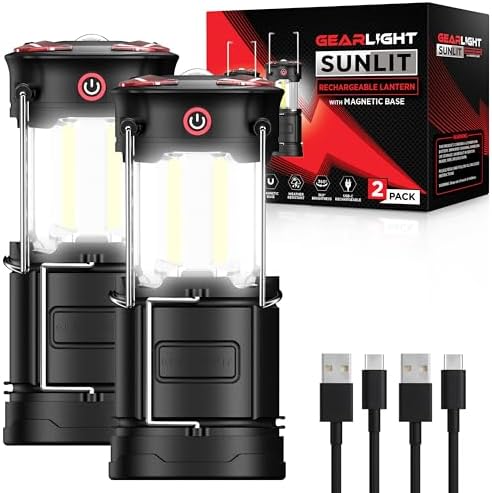
Best for Sites With No Charging Point
A hybrid model that takes solar as well as USB keeps a small light alive on a dispersed site where nothing gets plugged in for days. Solar rarely fills a lantern from empty in one day, so treat the panel as a trickle top up rather than the main charging route.
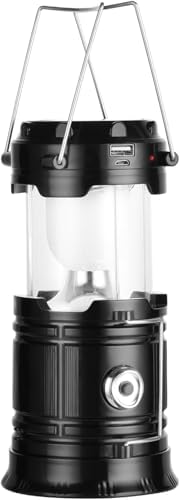
How the Options Compare
Three broad classes cover almost everything on the shelf, and they differ in what you give up. Size and battery capacity trade directly against packability.
| Class | Charging in | Charging out | Best job |
|---|---|---|---|
| Compact collapsible | USB-C on current models | Usually none | Tent light, one per person |
| Mid-size area lantern | USB-C | USB-A or USB-C, partial phone charge | Main light over the table |
| Large power bank lantern | USB-C, sometimes DC | Higher output, multiple ports | Group site plus device backup |
| Solar hybrid | USB-C plus panel | Varies, often limited | Dispersed camping with no power |
Cold Nights and Battery Behavior
Lithium batteries deliver less capacity in the cold, which is why a lantern that runs all evening in July feels short in October. It is not a fault and it is not permanent, the capacity comes back as the battery warms. Plan for shorter runtime on cold trips rather than assuming the lantern is failing.
The practical fix is simple: keep the lantern in the tent or in a jacket pocket rather than on the table overnight, and top it up during the day while the car is warm. On genuinely cold weekends, many campers keep one lantern that takes replaceable batteries as a backup, precisely because swapping cells works at any temperature.
Storage Between Trips
Lithium cells prefer to be stored partly charged rather than empty or full, and a lantern left flat in a bin over winter can be difficult to revive. Charge it to somewhere around half before it goes into storage, and give it a top up every few months. This is the single habit that most extends the life of a rechargeable lantern.
Common Mistakes With Rechargeable Lanterns
The biggest mistake is arriving with everything at zero. A rechargeable lantern has no equivalent of a spare set of batteries in the bin, so a lantern nobody charged is simply a paperweight. The fix is a charging check the night before the trip, alongside the headlamps and the phone battery.
The second mistake is buying on advertised battery capacity alone. A big cell in a lantern with harsh, undiffused light and two brightness steps is worse to live with than a smaller lantern that dims properly and puts out warm light. Judge the light first, then check that the battery is adequate for how long you camp between charges.
Frequently Asked Questions
Can a rechargeable camping lantern charge my phone? Many can, but expect a partial charge rather than a full one, and expect it to cost you most of an evening’s light. Use it as a backup, not as your main charging plan.
How do I charge a camping lantern at a campsite? From the car’s USB port or 12V socket while driving or idling, from a portable power station, or from a solar panel during the day. A powered site with a hookup makes it trivial.
How long does a rechargeable camping lantern last on one charge? It depends entirely on the brightness setting. Manufacturers publish runtime per mode, and the headline number is nearly always for the lowest setting, so check the full table before you rely on it.
Are solar camping lanterns worth it? As a supplement, yes, especially for dispersed camping with no power. As the only charging route they are slow, since a full recharge from empty usually needs more direct sun than one day at a shaded site provides.
Is USB-C worth insisting on? Yes. It means one cable for the whole kit, faster recharging from a car port or power station, and a model that has been updated recently rather than old stock.
Can I leave a rechargeable lantern in the car between trips? It is better not to. Heat and deep cold both shorten lithium battery life, and a lantern stored flat can be hard to revive. Store it indoors around half charged.
The Bottom Line
Buy the rechargeable lantern for its light: warm tone, real dimming, a usable hook, and USB-C charging. Treat the power bank function as insurance rather than infrastructure, because a lantern battery emptied into a phone is an evening spent in the dark. For the wider view of how camp lighting layers together, our camping lantern guide covers the fuel types and the brightness question, and charging a phone at camp explains the options that do not cost you your light.