Last updated: August 20, 2026
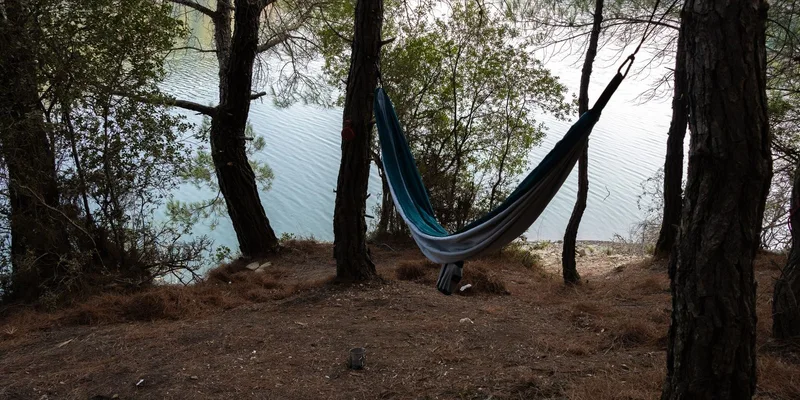
Most camping hammocks get bought for the afternoon, not for the night. You hang it between two trees at the edge of the site, and it becomes the place the kids read, the place somebody naps after lunch, and the place you sit while the coals get going. That job takes almost no gear: a hammock body, a pair of tree straps, and two trees the right distance apart.
Sleeping in one is a different project. Overnight comfort in a hammock comes down to hang angle, a bug net when the mosquitoes arrive, a tarp when the sky turns, and insulation underneath you, because a hammock offers nothing between your back and the cold air. This guide covers both uses, in that order, and points out where the marketing photos quietly skip a step.
This article contains affiliate links. If you buy through them, we may earn a commission at no extra cost to you. Learn more.
Quick Answer
What do you actually need for a camping hammock?
- Lounging at the site: hammock plus wide tree straps, nothing else.
- Bug season: an integrated or add on bug net, since a hammock has no walls.
- Rain: a separate tarp pitched above the ridgeline, not over the hammock body.
- Any night below mild: insulation underneath, because a sleeping bag compresses flat under you.
Bottom line: buy the straps with the hammock, and treat the net, the tarp, and the underside insulation as the three add ons that decide whether you sleep in it.
Straps Are Not an Accessory
A hammock without proper tree straps is half a product. Rope and thin cord bite into bark, which is why most campgrounds and land managers ask for wide webbing straps, and why every established brand sells them as the default suspension. Straps also make hanging faster, since you loop, thread, and clip rather than tie knots you have to remember.
The useful spec is length and adjustment points. ENO lists its Atlas straps as a pair of nine foot straps with fifteen adjustment points each, which is a fair benchmark for what car campers need: enough length to reach around a mature trunk and enough loops to fine tune the hang without re rigging.
Tree Care and Site Rules
Wide straps spread the load and protect bark, and Leave No Trace guidance at lnt.org is the right reference for minimizing impact when you hang anything from a tree. Some campgrounds and parks restrict or prohibit hanging hammocks from certain trees, or from trees below a given trunk size, so check the rules for the site you are visiting with the land manager before you rig.
Practical version: pick healthy mature trunks, avoid saplings, keep the straps flat rather than twisted, and never wrap a strap around a branch. If the only anchors on your site are small or dead, that is a site for a stand or for the tent, not for a hammock.
Sag Is the Whole Comfort Story
A hammock hung tight like a trampoline squeezes your shoulders and pushes your feet up, which is why a first night in one is so often uncomfortable. The fix is deliberate sag: hang the ends higher and let the fabric curve, then lie diagonally across the hammock rather than straight down the middle so your body flattens out.
Most hammock literature describes roughly a thirty degree strap angle as the starting point, and you can eyeball it as straps leaving the tree at a noticeably lazy angle rather than pointing straight at the hammock. Adjust from there, because trunk spacing on a real site never matches the diagram.
Trunk Spacing and Sitting Height
Two trees roughly twelve to fifteen feet apart is the comfortable working range for most single and double hammocks, and beyond that you run out of strap. Closer than that and you cannot get the sag without the seat dropping to the dirt. Walk the site and look for the pair before you unpack anything.
Hang height is worth a moment too. Set the lowest point of the seat around chair height so you can sit down and stand up normally, and so a rolled exit lands you on your feet rather than on your back. This matters more with kids and with older campers than any spec on the listing.
Camping Hammocks by Situation
Hammocks split cleanly by intended use: a lounger for the site, a two person size for sharing an afternoon, a netted model for bug season, a full shelter kit for sleeping out, and a stand for sites with no trees. Pick the situation, then compare capacity and fabric within it.
Best for Lounging at the Site
A double size nylon hammock plus straps is the version most families end up using. ENO’s DoubleNest is the reference point in this class, listed in 70 denier nylon taffeta with a stated capacity of 400 pounds, which comfortably covers one adult sprawled out or a parent and a small child reading.

Best for Bug Season
Once the mosquitoes are out, an open hammock stops being usable at dusk. A model with an integrated bug net, or a separate net that sleeves over the hammock, keeps the evening usable. ENO’s JungleNest, for example, is listed as a one person hammock with the bug net built in.

Best for Sleeping Out With Rain in the Forecast
To sleep in a hammock you need a tarp above it, pitched on its own ridgeline so the hammock can move without dragging the tarp. Shelter kits that bundle the hammock, straps, net, and rain tarp exist for exactly this, and buying them together avoids mismatched ridgeline lengths.

Best for a Site With No Trees
Plenty of campgrounds have gravel pads, young plantings, or open desert sites with nothing to hang from. A folding hammock stand solves that, at the cost of trunk space and weight. Check the stated capacity and the length the stand supports against the hammock you own.

Best Way to Stay Warm Underneath
A sleeping bag compresses flat where your body presses it, so the underside of a hammock has almost no loft left. Campers solve it with a closed cell or inflatable pad inside the hammock, or with an underquilt hung outside it. The pad route is cheaper and doubles as your ground pad.

Comparing the Hammock Setups
The four setups below are stages rather than competing products, and most campers add pieces over time. What changes between them is how much weather and how many bugs you can tolerate, and how long it takes to rig at the end of a driving day. Check capacities on the specific model rather than assuming the format.
| Setup | What it adds | Setup time | Good for |
|---|---|---|---|
| Hammock plus straps | A seat off the ground | A couple of minutes | Afternoons, reading, naps |
| Plus bug net | Usable after dusk | Add a few minutes | Mosquito season, humid sites |
| Plus tarp | Rain and dew cover | Longest to rig | Sleeping out, wet forecasts |
| Plus pad or underquilt | Insulation underneath | Minimal once packed | Cool nights, any overnight use |
Where Hammock Buyers Get Caught Out
Three surprises come up again and again: cold from below on the first night out, a tarp that touches the hammock and wicks water inside, and a capacity number that was read as a comfort rating rather than a limit. All three are avoidable, and all three are cheaper to fix before the trip than during it.
Take the capacity figure from the product listing for your exact model and treat it as a maximum, not a target. Two adults in a double hammock is common, but the fabric, the carabiners, and the straps each have their own published limits, and the weakest of the three is what governs.
Cold From Below
The complaint people describe as cold butt syndrome is simply the sleeping bag being squashed flat under body weight, leaving nothing between you and moving air. It shows up on nights that felt mild on the ground, which is why it catches first timers. A pad inside the hammock or an underquilt outside it is the standard answer.
If you already own a car camping pad, try that first before buying an underquilt. Wider rectangular pads stay put better inside a hammock than narrow tapered ones, and our sleeping pad guide covers how manufacturers publish R values so you can compare insulation honestly.
Frequently Asked Questions
How far apart should the trees be for a camping hammock? Roughly twelve to fifteen feet works for most single and double hammocks with standard straps. Closer and you cannot get enough sag, further and you run out of strap length. Walk the site and pick the pair before unpacking.
Can two people sleep in a double hammock? A double is sized for two people sitting or lounging, and many couples nap in one. For sleeping, most people find the two bodies roll together into the middle, which is why overnight hammock campers usually hang one each.
Do I need a bug net? In mosquito season, yes. A hammock has no walls, so anything flying can reach you from every side. Either buy a model with an integrated net or add a sleeve style net over the hammock you already own.
Why am I cold in a hammock on a mild night? Your sleeping bag compresses flat under your body, so the insulation underneath you is doing nothing. Add a sleeping pad inside the hammock or an underquilt outside it, and the problem usually disappears.
Are hammocks allowed at campgrounds? It varies. Many places allow them with wide webbing straps, some restrict which trees you may use, and some prohibit them outright. Check with the land manager or campground for the site you are visiting, and follow Leave No Trace guidance at lnt.org for minimizing impact.
What if my site has no trees? Use a folding hammock stand. Check that the stand’s stated length and capacity match your hammock, and be aware that a stand takes up meaningful trunk space compared with a hammock and straps.
The Bottom Line
Buy the hammock and the straps together, get the sag right before you judge the comfort, and treat the bug net, the tarp, and the insulation underneath as the three purchases that turn a lounger into a bed. Check the capacity on your specific model, respect the tree rules for the site, and hang low enough that getting out is easy. For overhead cover at the site more generally, see our camp shade comparison, and for the tarp itself, the camping tarp guide.