Last updated: August 20, 2026
Camp cooking goes wrong in the planning, not at the stove. Somebody picks recipes that each need three pans, a cutting board and twenty minutes of attention, and by the second night everyone has quietly agreed that sandwiches are fine. The meals were not too hard, they were too many moving parts for a picnic table with one burner free.
This guide is built around a single constraint: one burner, one pan, one pot of hot water. Every meal below works inside that limit, prepped mostly at home, cooked in one vessel, and cleaned up with a single wash. That is what makes camp cooking something you keep doing rather than something you survive.
This article contains affiliate links. If you buy through them, we may earn a commission at no extra cost to you. Learn more.
Quick Answer
What are the easiest camping meals to cook?
- One pan skillet meals: sausage and peppers, hash, fried rice, anything that starts by browning something.
- Foil packet meals, assembled at home and cooked on a grate or in coals.
- Boil and serve meals, where the pot only ever holds water.
- Assembly meals with no cooking at all, which is what arrival night should be.
Bottom line: prep at home, cook in one vessel, and give arrival night a meal that needs no stove at all.
Plan Around Prep, Not Recipes
The work that makes camp meals hard is chopping, measuring and portioning, and all of it can happen in your kitchen at home. Dice the onions and peppers, portion the rice, mix the spice blends, and put each meal into one labeled container or bag. At the site, cooking becomes pouring things into a pan in order.
This also cuts the trash you carry out and the water you use washing up, because a cutting board that never leaves home is a cutting board you never have to clean at a spigot. It is the single habit that separates people who cook well at camp from people who mean to.
Label Everything
Write the meal name and the day on each container. Two unlabeled bags of diced vegetables become an argument on night two, and a cooler where everyone knows what is what stays closed longer, which keeps the ice lasting.
One Pan Skillet Meals
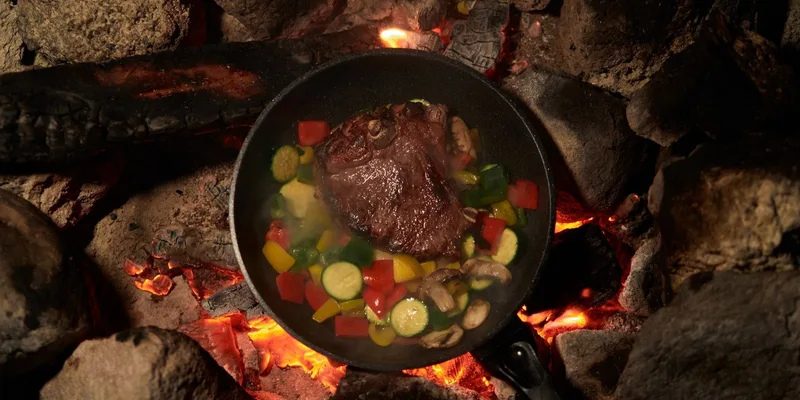
The skillet meal is the workhorse of camp cooking. Brown a protein, add aromatics, add a starch or vegetables, season and serve out of the pan. Sausage with peppers and potatoes, ground beef with rice and beans, breakfast hash with whatever is left over, chicken thighs with vegetables, all follow the same three step shape.
Cook these on a burner or a griddle rather than over an open flame, because a skillet over uneven fire scorches in one spot and stays cold in another. A single burner with decent simmer control handles all of them.
The Sequence That Always Works
Fat and protein first, then hard vegetables, then soft vegetables, then anything precooked, then seasoning at the end. Following that order means nothing overcooks while something else is still raw, and it works for almost any combination of ingredients you bring.

Foil Packet Meals
Foil packets are the classic camping meal because they are assembled at home and cooked with no pan to wash. Diced potatoes, a protein, vegetables, a fat and seasoning, sealed in a double layer of heavy duty foil, cooked on a grate over the fire or set on coals at the edge.
The two things that ruin them are thin foil, which tears and leaks, and packing everything too tightly, which steams the food into mush. Use heavy duty foil, double wrap, and leave a little air space inside the packet.
Cooking Them Safely
Packets go on a grate over the fire or on coals raked to the side, not into flames. Use long tongs and a heat resistant glove to move them, and open them away from your face because the steam that comes out is genuinely hot. For any meal containing meat, check doneness against the safe minimum internal temperatures USDA publishes rather than judging by appearance, and carry a small instant read thermometer.

Boil and Serve Meals
Some of the best camp meals never dirty a pan at all. Pasta with a sauce warmed in the same pot after draining, couscous or instant rice hydrated with boiling water, soup, chili from a jar or a home frozen batch, dumplings, noodles. The pot only ever holds water and the meal itself.
These are the meals for cold nights, bad weather and days when nobody wants to stand at a stove. They are also the ones that scale to a group most easily, because doubling the quantity is doubling the water rather than finding a second pan.
Freezing Meals as Ice
Home cooked chili, curry or stew frozen flat in a bag does double duty: it helps keep the cooler cold on the way out and it becomes dinner once it thaws. Follow the guidance USDA and FSIS publish on keeping cold food cold while traveling and camping rather than relying on how the bag feels.
Meals by Night of the Trip
Match the effort to the day. This is the pattern that works for most weekend trips.
| When | Meal type | Why it fits | Prep at home |
|---|---|---|---|
| Arrival night | No cook assembly | Camp is not set up yet | Everything, in one container |
| Day one breakfast | Griddle or skillet | Camp is set, everyone is up | Dice and portion |
| Day one dinner | Foil packets or skillet | Fire is going, time is free | Assemble packets fully |
| Last morning | Boil and serve | Packing up, minimal washing | Nothing, just water |
Arrival Night Should Never Involve a Stove
You get to the site later than planned, the tent still has to go up, and somebody is already hungry. Arrival night is not the time for a recipe. Sandwiches made at home, a wrap, cold pasta salad, a charcuterie board out of the cooler, anything that comes out of a container and onto a plate.
Pack it last so it is on top of the cooler, and eat it before the tent goes up rather than after. That single change removes most of the stress from the first hours of a trip, and it means the stove can wait until camp is properly set.
Food Safety at a Site
Camping removes the two things a home kitchen relies on, a refrigerator holding a steady temperature and a sink with hot running water. USDA and FSIS publish specific guidance for hiking, camping and outdoor cooking, covering how to keep cold food cold, how long perishables can be out and the safe minimum internal temperatures for meat and poultry. Use their figures rather than a rule of thumb.
The practical habits that follow from it are simple: keep raw meat sealed and at the bottom of the cooler, use separate bags and boards for raw and cooked, keep the cooler closed and in the shade, and carry an instant read thermometer instead of guessing at doneness by color.
Cleaning Up Without a Sink
Scrape food scraps into the trash, wash in one tub of hot soapy water and rinse in a second. Greywater goes where the campground directs, and where there is no facility follow the guidance from Leave No Trace at lnt.org and the land manager’s rules for the site you are visiting. Food scraps get packed out rather than scattered, which is also what keeps animals away from your site and your neighbors.

Frequently Asked Questions
What is the easiest meal to cook while camping? A one pan skillet meal built on the sequence of fat, protein, hard vegetables, soft vegetables, seasoning. It scales, it uses one vessel and it works with almost any ingredients.
How far ahead can I prep camping meals? Chopping and portioning are usually done the day before. For anything perishable, follow the cold holding guidance USDA and FSIS publish rather than estimating.
Do foil packet meals need a fire? No. They cook on a grate over a fire, on coals, or on a grill. Fire restrictions vary by location and day, so check with the land manager before planning around an open fire.
How do I keep meat safe in a cooler? Keep it sealed at the bottom of the cooler, keep the lid closed and the cooler shaded, and follow the cold food guidance USDA and FSIS publish for camping rather than judging by touch.
What should I eat the first night of a camping trip? Something that needs no stove at all, packed on top of the cooler and eaten before the tent goes up. Arrival night is the wrong time for a recipe.
How do I cook for a group on one burner? Choose boil and serve meals that scale by adding water, and prep everything at home. If you regularly cook for six or more, a third burner solves more than a bigger pan does.
The Bottom Line
Easy camping meals come from prep at home and a one vessel rule at the site, not from simpler recipes. Skillet meals, foil packets and boil and serve cover a whole trip, arrival night gets no stove at all, and food safety comes from published USDA guidance rather than instinct. If you need the hardware to match, our propane camp stove guide covers fuel planning and the camping cookware set guide covers what to cook it all in.