Last updated: August 20, 2026
Ten person tents get bought for two reasons. Either a genuinely large group is sharing one shelter, or a family of five decided that more space is always better and went two sizes up. Both are reasonable, and both run into the same set of practical problems: the packed bag is long and heavy, the tent needs a large flat pad that not every site has, and drying it out at home takes a bigger space than most garages offer.
What a ten person tent does exceptionally well is absorb gear. Big groups do not just bring more bodies, they bring more bins, more chairs, more bags and more wet boots, and having somewhere indoors to put all of that changes how a rainy weekend feels. This guide covers what ten really sleeps, what the site needs to look like, and where the honest limits are.
This article contains affiliate links. If you buy through them, we may earn a commission at no extra cost to you. Learn more.
Quick Answer
Who actually needs a ten person tent?
- Groups of six or seven with gear, or two families sharing one shelter with a divider.
- The rating means ten adult bags side by side, which is a floor area figure rather than a comfort figure.
- You need a large level pad, so check the site or the reservation listing before booking.
- Two smaller tents are often the better answer for mixed groups on tight sites.
Bottom line: buy a ten person tent for the gear space and the divided rooms, not because you plan to sleep ten in it.
What Ten Really Sleeps
Six or seven people with luggage is the realistic figure. The rating counts adult sleeping bags packed side by side across the floor with no gear, no walkway and nobody standing up, so it describes the floor area rather than a livable arrangement. Every manufacturer applies it the same way, which makes it a comparison tool rather than a plan.
In practice, the layouts that work are two queen air mattresses with a row of pads alongside, or three queens in the largest models, or a full row of pads for a scout style group with the gear stored in a vestibule.
The Gear Is the Real Reason
What separates a large group trip from a family weekend is the volume of stuff. Chairs, bins, a couple of coolers that must not sit in the sun, wet raincoats and everyone’s bags all want a home. A ten person tent gives you an indoor zone for that, which is worth more than the extra sleeping capacity.
The Site Has to Take the Footprint
This is the constraint people discover on arrival. Developed campgrounds often have a defined tent pad, and reservation systems frequently publish its size or a maximum tent footprint for the site. Check that figure against the tent’s floor dimensions before you book, not after.
On dispersed sites the constraint becomes level ground rather than a marked pad. A large footprint spans more terrain, so a slope or a hump you would not notice under a small tent turns into a sleeping problem. Walk the area, find the largest genuinely flat patch, and be prepared to move if it is not big enough.
Where Not to Pitch It
Avoid low ground where runoff collects, avoid the crest of a rise where wind hits hardest, and look up for dead limbs before committing. A big tent takes long enough to pitch that nobody wants to move it once it is standing.
Ten Person Tents by Situation
Large tents differ mostly in body shape, room dividers and fly coverage. Pick on the layout you need rather than on the largest number available.
Two Families Sharing One Tent
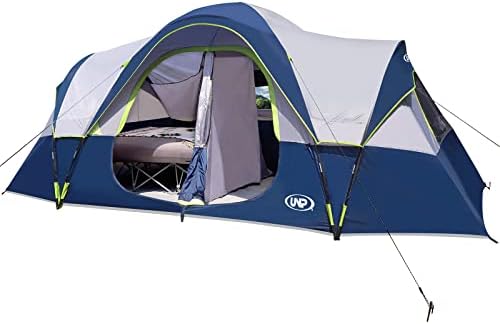
A divided cabin body with two doors is what makes this work, so each family has its own entrance and its own half rather than crossing the other’s sleeping area.

Scout Group or Friends on Pads
A single large volume without dividers is simpler and takes a full row of sleeping pads, with a vestibule or a screened area for gear.
You Want It Standing Quickly
Instant frames scale to this size too, with poles pre attached and legs that extend rather than assemble. Ozark Trail and CORE both publish setup times of roughly two minutes for their large instant cabins.

The Group Will Be Rained On
Fly coverage matters more as tents get bigger, because there is more wall for water to run down. Look for a fly that reaches the ground and a covered entry big enough for a pile of boots.

Bug Season Near Water
A screened room attached to the tent, or a separate screen shelter beside it, gives the group somewhere to eat without insects, which matters more at this group size than at any other.

One Big Tent or Two Smaller Ones
For groups above six, this is the real decision, and it is not obvious in either direction. The table below sets out the trade honestly.
| Approach | Strength | Weak spot | Best when |
|---|---|---|---|
| One ten person tent | Shared gear space, one pitch | Needs a large flat pad | One group, one site, longer stay |
| Two six person tents | Flexible siting, easier to dry | Two pitches, gear split up | Mixed groups, uneven ground |
| Large tent plus screen shelter | Sleeping and living separated | Most to carry and set up | Bug season, week long stays |
Handling a Tent This Size
A ten person tent is a two person job to pitch and a two person job to fold. Assign roles before you start rather than improvising, with one person at each end of the frame and someone else running stakes. Stake every corner, then tension every guyline, since a body this large gives wind a lot to work with.
Drying it afterward is the part nobody plans for. A tent this size needs a garage floor, a lawn or a long fence to spread out on, and it needs to be fully dry before it goes into storage. Folding a large tent away damp is the fastest route to a ruined coating and a smell that does not leave.
Splitting the Load
Some groups carry the poles and the body in separate bags to make the tent manageable, and to spread the weight across two vehicles. It also makes the original stuff sack less of a wrestling match, since factory bags are usually cut exactly to size.
Frequently Asked Questions
How many people fit comfortably in a ten person tent? Six or seven with their gear. The rating counts adult sleeping bags side by side with nothing else on the floor, so it is a floor area measure rather than a comfort measure.
Will three queen air mattresses fit? In the largest models, sometimes. Compare your mattress dimensions against the floor dimensions published on the listing rather than assuming, and leave a walking strip to the door.
Is a ten person tent too big for a campground site? It can be. Many reservation systems publish a tent pad size or a maximum footprint for each site, and large tents are the ones most likely to exceed it. Check before booking.
Can two people set one up? Yes, and two is the sensible minimum. One person can manage an instant frame in this size with effort, but a conventional pole model is a genuine two person job.
Is one big tent better than two smaller ones? One tent keeps the group together and shares the gear space. Two tents pitch on smaller patches of level ground, dry faster and give mixed groups more privacy. Site conditions usually decide it.
How do I store a tent this size? Fully dry, loosely folded rather than compressed, somewhere that is not damp. The most common way a large tent gets ruined is being packed away wet after the last trip of the season.
The Bottom Line
A ten person tent earns its place with big groups that need indoor gear space and divided rooms, not with families chasing a bigger number. Check the site can take the footprint, plan on two people to pitch and fold it, and dry it thoroughly before storage. Our eight person tent guide covers the size most families actually need, and the screen house guide is worth reading if bugs are the reason you want more covered space.