Last updated: August 20, 2026
Hot water at a campsite comes from one of two places: a propane burner heating water as it flows, or electricity heating or moving water you warmed some other way. Those two routes cost different amounts, weigh different amounts, and carry very different safety obligations.
This comparison is written for car campers with a site, a vehicle and no hookup. It is not about plumbing anything into a camper. The question is simply which of the two approaches gives a family a warm wash at the end of a day, and what each one asks of you in return.
This article contains affiliate links. If you buy through them, we may earn a commission at no extra cost to you. Learn more.
Quick Answer
Propane or electric for a camp shower with hot water?
- Propane tankless heaters give continuous hot water and are the only realistic option for a family washing in sequence.
- They are combustion appliances, so makers instruct outdoor use only, and a carbon monoxide alarm belongs in your kit.
- Electric setups mean a battery pump moving water you heated on the camp stove, which suits one or two people.
- Solar bags sit below both and depend entirely on the weather that day.
Bottom line: propane for a family and for continuous flow, electric for simplicity and for couples.
What Is Actually Being Compared Here
On one side is a portable propane tankless water heater: a burner, a heat exchanger and a pump, running from a propane cylinder and a garden hose or a water container. On the other is an electric setup, which in practice means a rechargeable pump shower drawing from a bucket of water you heated on the camp stove.
Only the first one heats continuously. The second is a delivery system for water you have already warmed. That single difference decides most of the outcome, because a family of four in sequence needs a supply that keeps producing rather than a bucket that empties.
Propane Tankless Heaters: Continuous Hot Water Outdoors
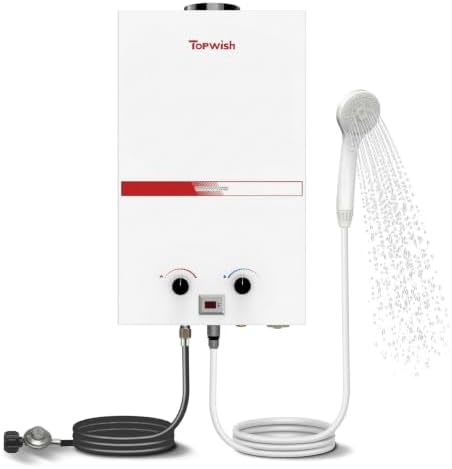
A portable propane water heater burns gas to heat water as it passes through a coil, so the flow stays hot until the propane or the water runs out. Camplux, Eccotemp and Camp Chef all sell units aimed at camping, each publishing its flow rate, heat output and minimum water pressure on the listing.
These are the only camp showers that behave like a household shower. They also introduce a burner into your camp, which is where the responsibilities begin, and they need three things at once: propane, water under some pressure, and usually batteries for the ignition.
Safety comes from the manufacturer, not from us
A propane water heater is a combustion appliance and the manufacturers instruct that these units are for outdoor use. Do not run one inside a tent, a privacy shelter, an awning, a vehicle or any enclosed space. Clearances, ventilation requirements and cylinder handling come from the unit’s own manual and from NFPA guidance on fuel gas, and those documents are the ones to follow rather than any figure quoted secondhand.
Carry a battery carbon monoxide alarm whenever a fuel burning appliance is part of your camp, and place it where you sleep. It costs little, it lasts years, and it is the standard recommendation for anyone camping with propane equipment of any kind.
Electric Setups: Simpler, Smaller, No Flame
The electric route is a rechargeable submersible pump on a hose with a shower head, dropped into a bucket of water you have mixed to temperature. There is no burner, no cylinder and nothing to vent, which removes the entire safety conversation above in one step.
Ivation makes the version most car campers meet, charged over USB and rated for a stated runtime per charge. Larger battery powered shower systems exist too, and a few can be paired with a power station, though heating water electrically at a campsite draws far more energy than most portable batteries will comfortably supply.
Where it runs out
It runs out at volume. Boiling a kettle and mixing a bucket works beautifully for one or two people and becomes tedious for four. If your group is larger, either accept several rounds of kettle boiling or move to the propane side.
Differences in One Look
| Approach | Hot water supply | What it needs at camp | Main obligation |
|---|---|---|---|
| Propane tankless | Continuous while gas and water last | Cylinder, water source, batteries for ignition | Outdoor use only, CO alarm in the kit |
| Battery pump plus kettle | One bucket at a time | Charged pump, stove, bucket | Keeping the pump charged |
| Solar bag | Whatever the sun delivered | Sun, somewhere to hang it | Planning around the weather |
| Campground shower block | Unlimited | Coins or a token, a walk | Queueing at peak times |
Which Camper Are You?
Families of four or more washing in sequence, groups sharing a site, and anyone camping into the shoulder season want the propane route, because it is the only one that keeps producing hot water without repeated boiling. Couples, solo campers and anyone who prefers not to add a burner to camp are better served by the electric route.
There is also a middle path that gets overlooked: a solar bag left in the sun all day, topped up with a kettle of boiling water at dusk to bring it to a comfortable temperature. That costs almost nothing and covers a surprising number of summer weekends.
Best for a family that wants continuous hot water
A portable propane tankless heater with its own pump handles several people in a row. Set it up outdoors, follow the manual for clearances and cylinder connection, and keep the shower head and hose inside the privacy shelter while the unit itself stays outside it.
Best for couples and simple setups
A rechargeable pump shower plus a bucket lets you mix water to the temperature you actually want. Nothing burns, nothing vents, and the whole kit stows in a small bag between trips.

Best low effort backup for summer
A solar shower bag left in the sun covers the easy days and takes a kettle of hot water when the sun did not cooperate. It is the cheapest hot water at camp and the least demanding to store.

Avoid This Mistake
The mistake that matters is bringing a propane water heater into an enclosed space to stay warm or out of the wind. Manufacturers instruct outdoor use for these units, and a privacy shelter with the door zipped is an enclosed space. Run the heater outside the shelter and route only the hose and head inside.
The second mistake is a water supply problem rather than a heating one. Propane heaters state a minimum water pressure on the listing, and a gravity fed container often will not reach it. Check whether your unit includes a pump or expects a garden hose before you order.
The scald risk people forget
Water from a tankless unit arrives hot immediately and children reach for the head first. Set the temperature control down before anyone gets in, test the flow on your own hand, and keep the unit’s controls where an adult can reach them from outside the shelter.
Frequently Asked Questions
Can I use a propane camp water heater inside a shower tent? No. Manufacturers instruct outdoor use for these combustion appliances, and a zipped privacy shelter is an enclosed space. Keep the unit outside and pass the hose and shower head in.
Do I need a carbon monoxide alarm when camping with propane? Carrying a battery alarm is the standard recommendation whenever any fuel burning appliance is part of your camp, including stoves, heaters and water heaters. Place it where people sleep.
How much propane does a camp water heater use? The unit’s listing and manual state its heat output and consumption, and that figure varies widely between models. Read it for the specific heater you are considering rather than working from a general number.
Can I run a camp water heater off a power station? Propane models only need batteries for ignition and a pump, which a small power bank handles. Heating water electrically is a different matter and generally asks more of a portable battery than it can sensibly deliver.
Is a solar shower warm enough? On a sunny day, often yes. On a cloudy one, no. Topping a solar bag up with a kettle of boiling water at dusk is the common fix, and it is what makes the format usable outside of high summer.
What water pressure does a propane heater need? Each maker publishes a minimum starting pressure on the listing, and gravity fed containers frequently fall short of it. If you do not have a hose connection at the site, choose a unit that ships with its own pump.
The Bottom Line
Choose propane if you need continuous hot water for a family, and accept the obligations that come with a burner: outdoor use as the manufacturer instructs, clearances from the manual, and a carbon monoxide alarm where you sleep. Choose electric if you are one or two people who would rather boil a kettle and mix a bucket than manage a cylinder. For the delivery side of the setup see our guide to a portable camping shower with real pressure, weigh the free option in our solar shower guide, and give the whole thing somewhere to stand with a shower tent that drains properly.