
Last updated: August 20, 2026
Plenty of campgrounds hand you a site with a picnic table bolted to a concrete pad, a fire ring, and almost nothing else. The gap between the tent door and that picnic table is where a small camp table earns its keep, holding a lantern, a water bottle, a phone charging off a battery, and the bug spray somebody is always looking for. On a tight site, a full length folding table will not fit anywhere useful, and it will spend the weekend leaning against the car.
Small camp tables are also the pieces people buy twice, because the first one turns out to be either too low to reach from a camp chair or too flimsy to hold a cast iron pan. This guide covers what small actually means in this category, how to measure the space you have before you order, and which format suits a cramped site, a beach site, or the strip of dirt beside a truck tailgate.
This article contains affiliate links. If you buy through them, we may earn a commission at no extra cost to you. Learn more.
Quick Answer
Which small camping table fits a tight site?
- Beside a camp chair: a low side table at roughly chair armrest height, not a dining height table.
- Beside a stove or cooler: a compact table at standing prep height so you are not bending over.
- Packing into a full trunk: a roll top aluminum table that flattens to a slim panel.
- Sand or soft ground: wide feet or a low slung frame, since narrow legs sink.
Bottom line: pick the height first, because a small table at the wrong height is the one that stays in the car.
What Counts as a Small Camp Table
A small camp table is one that seats nobody. It exists to hold objects within arm’s reach of where you are already sitting or cooking, so its useful dimensions are height and stability rather than surface area. Most models in this class have tops in the range of a large cutting board, and they fold or roll into a bag you can carry with one hand.
That is a different product from a folding camp table meant for eating. A dining table has to be tall enough for chairs and long enough for plates, which forces a bigger folded footprint. Most campers end up with one of each, and the small one is the one that gets set up every trip.
Side Table Versus Compact Prep Table
Side tables sit low, usually near the armrest height of a camp chair, so you can set a mug down without leaning. Compact prep tables stand higher and are meant to carry a stove, a dish tub, or a stack of plates. Trekology, for example, lists its small camping table at a tabletop of about 15.5 by 13.6 inches with a stated weight capacity of 50 pounds, which is typical of the light aluminum side table format.
The mistake is buying a low side table and expecting to prep on it. Cutting vegetables at knee height is miserable, and a table built for a mug will flex under a full pot.
Measure the Gap Before You Order
Measure three things at home: the height of your camp chair armrest, the width of the clear space where the table will actually live, and the free depth left in the trunk after the cooler and the tent go in. Small tables are bought on those three numbers, not on the product photo, and every one of them is easy to check with a tape measure.
Site geometry matters too. On many campgrounds the usable flat ground is the tent pad plus a narrow apron around the picnic table, and the rest slopes. If your clear apron is two feet wide, a table that folds out to three will sit crooked all weekend.
Small Camp Tables by Situation
The right small table depends on where it sits and what it holds. Below are the four situations that cover almost every tight site: a chairside table, a low profile table for sand, a compact prep table beside the stove, and a slim roll top for a packed trunk. Match the situation first, then compare models within it.
Best for a Chair and a Mug
A low aluminum side table at roughly armrest height keeps a drink, a headlamp, and a book off the dirt without blocking the path between chairs. Look for a top that is solid rather than slatted if you want to set down a small mug without it tipping into a gap.

Best for Sand and Soft Ground
Narrow tube legs sink into sand and loose duff, which is why beach and dune campers reach for a low slung table with broad feet or a wide footprint frame. A shorter table also stays put in wind better than a tall one, since there is less leverage on the legs.

Best for a Stove or Dish Tub
Beside a two burner stove you want standing prep height and a top that tolerates a hot pan being set down. Aluminum tops handle heat better than plastic ones, and manufacturers such as GCI Outdoor describe their aluminum camp tabletops as heat resistant for exactly this reason.

Best for a Trunk With No Room Left
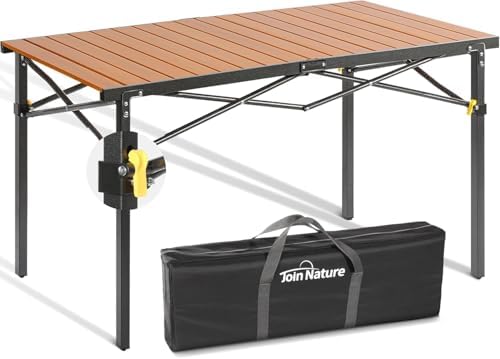
Roll top tables give you the most usable surface for the least folded thickness, because the top rolls rather than folds. That makes them the practical choice when the cooler, the tent, and a bin of kitchen gear have already claimed the trunk.
Comparing the Small Table Formats
The four formats below differ mainly in height, in how they pack, and in how much abuse the top will take. None of them is a dining table, and none of them replaces the picnic table you were given. Use this to narrow the shortlist, then check the actual dimensions on the listing of the model you are considering.
| Format | Typical height | Packs to | Best job |
|---|---|---|---|
| Low side table | Near chair armrest | Small pouch | Drinks, headlamp, phone beside a chair |
| Beach or sand table | Lowest of the four | Flat panel | Soft ground, windy open sites |
| Compact prep table | Standing height | Clamshell case | Stove, dish tub, cutting board |
| Roll top table | Usually adjustable | Slim rolled bag | Full trunk, mixed duties |
Where Small Tables Fall Down
The common failures are predictable: legs that sink, tops that flex under a hot pan, and locking hinges that loosen after a season of being packed damp. None of these are dramatic, but they are the reason a table gets replaced. Knowing them in advance lets you choose a model that avoids the one you care about.
Weight capacity is the number to take from the listing. Manufacturers publish a figure for their own model, and it varies widely across tables that look nearly identical in photos.
Stability on Uneven Ground
Almost no campsite is flat, and small tables rarely have adjustable legs. The usual fix is a flat rock or a scrap of wood under one foot, which has to be redone every time you move the table. If you camp mostly on gravel or root covered ground, a model with independently adjustable legs is worth the extra folded bulk.
Frequently Asked Questions
What is the smallest camping table worth buying? The smallest useful size is one that holds a mug, a headlamp, and a phone without tipping, which in practice means a top around the size of a large cutting board. Anything smaller becomes a coaster on legs.
How tall should a small camping table be? That depends on the job. A table meant to sit beside a camp chair should be near armrest height, while a table meant to hold a stove or a dish tub should be at standing prep height so you are not bending over your cooking.
Can a small camping table hold a camp stove? Only if the listing supports it. Check the manufacturer’s stated weight capacity and whether the top is aluminum, since aluminum tops are the ones described as heat resistant. Setting a stove on a plastic top that was not built for it is a common way to ruin a table.
Do I still need a small table if the site has a picnic table? Most campers say yes. The picnic table is usually where the food and the stove live, so a small table beside the chairs or beside the tent door keeps the things you reach for at night off the ground and out of the dirt.
What keeps a small table from sinking into sand? A wider foot or a low slung frame spreads the load. Some campers also set flat pavers or scrap plywood under the legs. On beach sites, a lower table is generally more stable than a taller one in the same wind.
The Bottom Line
A small camp table is bought on height, folded thickness, and stated capacity, in that order. Decide whether it lives beside a chair or beside the stove, measure the clear space on your site and the space left in the trunk, and take the weight capacity from the manufacturer rather than guessing. If you want one table that can also feed the family, our camping table guide covers the full size options, and the folding camping table guide compares the folding formats in more detail.