Last updated: August 20, 2026
A folding table either sits rock steady for the whole weekend or it develops a rocking corner on the first night and never loses it. The difference usually comes down to two things nobody looks at in the listing: how the legs lock, and whether the height can be adjusted enough to deal with ground that is not flat. Campgrounds rarely offer flat.
Folding tables are also the piece of camp furniture people buy once and keep for a decade, which makes it worth getting right. This guide covers the leg mechanisms, the height settings that actually matter, and the checks that separate a table you trust with a full pot from one you do not.
This article contains affiliate links. If you buy through them, we may earn a commission at no extra cost to you. Learn more.
Quick Answer
What makes a folding camp table steady?
- Legs that lock positively, with a catch or a pin, rather than resting against a stop.
- Independently adjustable legs, which let you level the table on ground that is not flat.
- A frame that braces across the diagonal, since side to side sway comes from missing bracing.
- Published height settings that match both sitting and standing use.
Bottom line: buy for the leg locks and the height range, and level the table with the legs rather than with a folded napkin.
The Leg Mechanisms and How They Fail
Three designs cover almost all camp tables. Push button telescoping legs, folding steel legs with a spring catch, and X frame legs that tension against the tabletop. Each holds well when new, and each has a characteristic way of going loose after a couple of seasons.
Telescoping legs wear at the button hole and start to drop under load. Spring catch legs stop clicking fully home once grit gets into the mechanism. X frames loosen when the fabric or cord under a roll top stretches. Knowing which failure to expect tells you what to check before each trip.
Height Settings That Are Worth Paying For
The useful thing about adjustable height is not the number of settings but their spread. A table that offers a normal dining height plus a standing prep height covers two different jobs, and manufacturers publish these figures. ALPS Mountaineering lists its Overlanding table with settings of 29, 31 and 36 inches, which is the pattern to look for.
Low settings matter too if you use low chairs. Some tables drop to a height that works beside a low lounger at a fire ring, which is a different setup from eating at a picnic table and needs a different number.
Independently Adjustable Legs
The best reason to want adjustable legs has nothing to do with your own height. On sloping ground, being able to shorten the uphill legs and lengthen the downhill ones levels the surface properly, which no amount of shimming a fixed leg table will match.
Fold in Half, Roll Up or Flat Fold
Fold in half tables crease down the middle and carry like a briefcase, which is why household folding tables from brands like Lifetime end up at so many campsites. Roll up tables wrap their tops around an X frame and pack into a bag. Flat fold tables stay one piece and take the most space.
Pack shape decides more than pack volume in a loaded car. A briefcase table slides flat against the seat back, a rolled bundle wedges into gaps, and a rigid one piece table needs a space of its own that has to be planned for.
Folding Camp Tables by Situation
The four cases below cover most buyers: the family dining table, a compact prep table, an adjustable table for sloped sites, and a small side table for a tight pad.
Best Fold in Half Table for Family Meals
A blow molded fold in half table gives a solid surface for four and carries like a case, with height settings on most models.

Best Roll Up Table for Prep
An aluminum roll top on an X frame packs smallest and gives a stable working surface beside the stove.

Best Adjustable Table for Uneven Sites
Independently adjustable legs let you level the top on a slope instead of accepting a rocking corner all weekend.
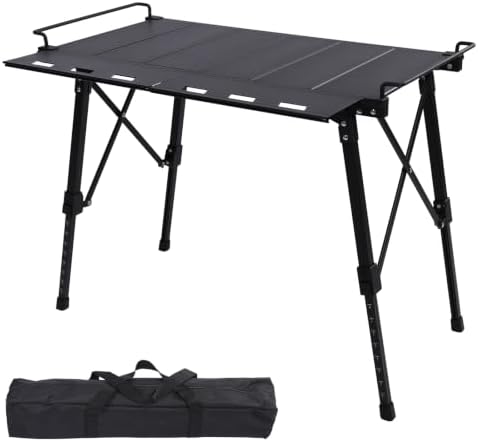
Best Small Folding Table for a Tight Pad
A compact folding side table carries a lantern and drinks without taking up the walking space between tent and fire.

Comparing Folding Designs
The table below matches each folding style to its strengths. All of them work on a level pad; the differences show up on slopes, in wind and in a full car.
| Folding style | Leg lock | Levels on a slope | Carries as |
|---|---|---|---|
| Fold in half | Spring catch | Only if legs adjust | A flat case |
| Roll up X frame | Frame tension | Limited | A shoulder bag |
| Telescoping leg | Push button | Yes, leg by leg | Flat or rolled |
| Flat fold one piece | Folding brace | Rarely | A rigid panel |
The Steadiness Check Before You Load It
Set the table up, put both hands flat on one corner and press down, then push the corner sideways. Vertical give means a leg is not locked or a catch has not clicked home. Sideways sway means the bracing is doing less than it should, and that is the movement that spills drinks.
Do this before the stove and the food go on rather than after. It takes ten seconds, it catches the leg that did not lock, and it is the difference between finding a problem now and finding it when a pot is full.
Mistakes That Shorten a Table’s Life
The first is packing it away wet and gritty. Sand in a telescoping leg grinds the tube, and a damp top folded shut grows marks that never quite wipe off. A quick wipe and an open air dry before the table goes in the bag costs a minute.
The second is using the table as a step or a seat. Camp tables are built to carry a load spread across the top, not a person’s weight on one edge, and the published capacity figures assume normal use rather than someone standing on a corner to reach the tent roof.
Frequently Asked Questions
How do I stop a camp table wobbling? Level it with the legs if they adjust independently, and check every leg lock is fully engaged. If the legs are fixed, move the table to flatter ground rather than propping one leg, since a propped leg shifts as soon as weight moves.
What height should a folding camp table be? Normal dining height for eating and higher for standing prep. Look for a table with published settings that cover both, such as the 29, 31 and 36 inch range ALPS lists on its Overlanding table.
Are fold in half tables sturdy enough for camping? The blow molded ones are, which is why they turn up at so many sites. Check the maximum weight published for the specific model, since figures differ between consumer and commercial lines within the same brand.
Can you leave a folding table outside overnight? Most handle dew and rain, but water sitting in telescoping legs and grit in the catches shorten the life of the mechanism. Fold it down and store it under the tarp or in the car if the forecast is wet.
Do folding tables fit in a small car? Fold in half tables slide flat behind a seat, roll up tables wedge into gaps, and rigid one piece tables need planned space. Measure the folded dimensions rather than trusting the category name.
Is aluminum or plastic better for a camp table? Aluminum tops pack smaller and shed water; plastic tops give a solid surface that wipes clean and usually carries more. The right answer follows from whether the table is mainly for prep or mainly for meals.
The Bottom Line
Buy for the leg locks and the height range, then run the ten second steadiness check every time you set up. Independently adjustable legs are what let a table stay level on real campground ground, and they are worth more than an extra inch of tabletop. For tabletop materials see our camping table guide, and if you want the surface and the storage in one unit, look at a camp table with storage.