Last updated: August 20, 2026
A family tent gets judged on three nights a year and lives in a garage for the other three hundred and sixty two. That is exactly why people buy the wrong one. The tent that looks enormous in a product photo is often the one that takes two adults forty minutes to pitch while three kids get bored, and the one with the best rain rating is often the one nobody can lift onto the roof rack.
The useful way to shop is to work backward from your actual trips. How many bodies, how many sleeping pads or air mattresses, how much rain, how often you move sites, and how much of the car is already full. This guide covers what floor area really buys you, why person ratings run optimistic, which rain features matter, and how setup time changes the whole experience with kids in tow.
This article contains affiliate links. If you buy through them, we may earn a commission at no extra cost to you. Learn more.
Quick Answer
What should you look for in a family camping tent?
- Buy at least two person ratings above your headcount, because the rating assumes bodies side by side with no gear.
- Check the floor dimensions against your actual mattresses, not the person number on the box.
- A full coverage rainfly and a bathtub floor matter far more than any single waterproof number.
- Setup time is a real feature: an instant frame beats a pole sleeve tent when kids are waiting.
Bottom line: size on floor dimensions and mattress footprint, then choose between rain performance and setup speed based on where you camp.
Why Person Ratings Run Optimistic
A tent’s person rating describes how many adult sleeping bags fit shoulder to shoulder on the floor with nothing else in the tent. It is a packing measurement, not a comfort measurement. A four person tent sleeps four adults the way an elevator holds its rated load, technically and unpleasantly.
The practical rule most families land on is to add two. A family of four is comfortable in a six person tent, a family of five wants an eight person tent, and a group that brings cots or queen air mattresses needs to size on the mattress footprint instead of the headcount entirely.
Size on the Mattress, Not the Number
Measure whatever you plan to sleep on and lay it out on the living room floor. Two queen air beds side by side need a genuinely large floor, and the manufacturer publishes the floor dimensions for every tent. Compare those figures directly against your mattresses and leave a walking strip along one edge.
The Rain Features That Actually Matter
Rain performance in a family tent comes down to three things: how far the rainfly reaches down the walls, whether the floor is a bathtub design with the seams above ground level, and whether the seams are sealed or taped. A tent with a partial fly over the roof only is fine in a shower and unpleasant in a storm.
Full coverage flies also give you a covered entry, which is where wet shoes and packs live so they are not in the sleeping area. On a rainy weekend that vestibule area is the difference between a manageable trip and a tent full of damp gear.
What Waterproof Ratings Do and Do Not Tell You
Manufacturers publish hydrostatic head figures for fabric, and Coleman publishes its own weather system specification covering welded floor corners and inverted seams. Those figures describe fabric and construction, not the pitch. A well sealed tent pitched with a slack fly still lets water in where the fly touches the inner wall, so tension is part of the waterproofing.
Setup Time Changes the Trip
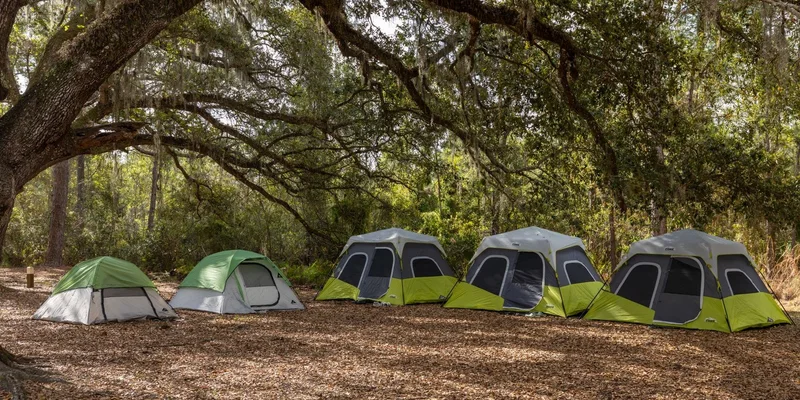
Traditional pole tents thread poles through sleeves or clip them to the body and take two people a while on the first few attempts. Instant tents arrive with the poles pre attached to the frame, so you unfold, extend the legs and stake out. Coleman, CORE and Ozark Trail all publish setup times in the region of one to two minutes for their instant cabin models.
That difference matters most when you arrive late, when it is raining, or when you move sites often. It matters least on a week long stay in fair weather, where a slower tent that packs smaller and handles wind better is the better trade.
Family Tents by Situation
Once size and setup style are settled, the remaining choice is about your specific weekend. Here is how the common cases usually break down.
The Standard Family Weekend, Four to Five People
A six person dome or cabin tent with a full coverage fly covers most family campground trips, with room for two air mattresses and a corner for bags. This is the size that fits in most trunks without an argument.

You Want to Stand Up Inside
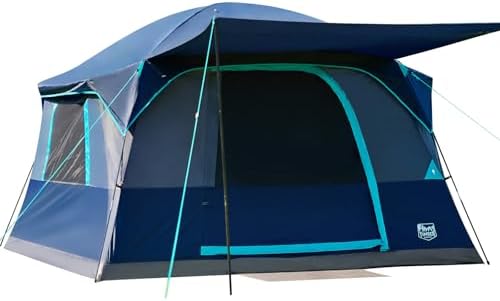
Cabin style tents trade a little wind performance for near vertical walls and real standing headroom, which changes how a rainy afternoon feels when everyone is stuck inside.
Arriving Late and Pitching in the Dark
An instant tent with pre attached poles is the answer here. You give up some packed size and some storm performance, and you get a standing tent in a couple of minutes.

Two Families or Kids Who Want Their Own Space
Larger tents with room dividers split into separate sleeping areas, which is worth more for peace than for space. Check the divider is included rather than sold separately.

Summer Trips Where the Tent Bakes at Sunrise
Dark walled tents block a large share of daylight and reduce the greenhouse effect in the morning. Coleman publishes a figure for how much light its Dark Room fabric blocks compared with a standard Coleman tent.

Comparing the Main Family Tent Styles
Three body shapes dominate the family category, and each is a different compromise between weather, headroom and packed size.
| Style | Headroom | Wind and rain | Best for |
|---|---|---|---|
| Dome | Highest at the center only | Strongest of the three | Exposed sites, shoulder season |
| Cabin | Near vertical walls throughout | Catches more wind | Sheltered campgrounds, longer stays |
| Instant cabin | Similar to cabin | Depends on staking and guying | Late arrivals, frequent moves |
Mistakes That Cost People a Weekend
The most common one is skipping the guylines. A large tent with unattached guy points behaves badly in the first real gust, and the lines are already in the bag. Stake the corners, then run the guylines out and tension them, every time, even when the forecast is calm.
The second is pitching in a dip. Water collects in low ground and no floor keeps up with standing water. Walk the site, look for the high point with a slight crown, and check for the faint channels that show where runoff goes.
Practice Once Before the Trip
Pitch a new tent in the yard or a park once before you take it camping. You find the missing stake bag, the pole that goes in a specific order, and the door that only zips smoothly one way, and you find all of it in daylight with no audience.
Frequently Asked Questions
What size tent do I need for a family of four? A six person tent is the usual answer, since person ratings assume adults packed side by side with no gear. If you sleep on air mattresses rather than pads, check the floor dimensions against the mattresses instead of trusting the rating.
Are cabin tents worse in wind than dome tents? Generally yes, because the vertical walls present more surface to a gust. Staking every corner and tensioning the guylines closes much of the gap, but on an exposed site a dome remains the safer shape.
Is an instant tent worth it? If you arrive after dark, move sites often, or camp with impatient kids, the time saved is real. If you camp on exposed sites in shoulder season, a conventional pole tent with a full coverage fly is usually the stronger choice.
Do family tents need a footprint? Not always, but a ground sheet under the floor extends the life of the tent and adds a barrier against abrasion and damp. Cut any ground sheet slightly smaller than the floor so it does not channel rain underneath.
How long does a family tent last? That depends far more on storage than on nights used. Packing a tent away damp is the single fastest way to ruin the coating, so dry it fully at home after every trip.
Can one person pitch a large family tent alone? Instant frames yes, most large cabin tents with a fly, awkwardly. If you often camp without a second pair of hands, treat single person setup as a selection criterion rather than an afterthought.
The Bottom Line
A good family camping tent is the one sized on your mattresses rather than on a person rating, with a fly that reaches the ground and a setup style that matches how you arrive. Coleman, CORE, Ozark Trail and Kelty all build in this space, and the differences that matter are floor dimensions, fly coverage and setup time. For a closer look at sizing, our tent for a family of four guide works through the trunk space question, and the cabin tent guide covers standing room in more detail.