Last updated: August 20, 2026
The picnic table is the reason most camp kitchens feel cramped. It sits at bench height, which is too low to chop at comfortably, it is often on a slope, it is usually damp or sticky from whoever had the site before you, and by the time the stove and the cooler are on it there is nowhere left to put a cutting board.
A camp kitchen table fixes all four problems at once by giving the stove its own surface at working height, with side shelves for prep and a rack underneath for everything that would otherwise live on the ground. This guide covers what to look for, how the load ratings translate to real gear, and when a simple folding table does the job just as well.
This article contains affiliate links. If you buy through them, we may earn a commission at no extra cost to you. Learn more.
Quick Answer
What should a camp kitchen table have?
- A heat resistant main surface rated to carry a camp stove, not a plastic top that warps.
- Prep space either side of the stove, because the stove itself claims the middle.
- Adjustable or level feet, since campground ground is rarely flat.
- A lower rack or shelf that keeps gear off the dirt and out of the walking lane.
Bottom line: buy for the surface rating and the side shelves, then check the packed size against your trunk before anything else.
Prep Height Changes How You Cook
A picnic table puts the cooking surface at seated height, which means chopping and stirring from a stoop. A camp kitchen table puts the stove at standing height, roughly where a kitchen counter sits. Over a long meal that difference is the reason one cook finishes relaxed and another finishes with a sore back.
It also changes the geometry of the site. With the stove off the picnic table, the table becomes what it is for, a place to eat and prep, and two people can work without reaching across each other or across a hot burner.
The Safety Side of Height
Standing height also puts the flame above the level a toddler or a dog reaches without effort. That is not a substitute for supervision, but it removes the situation where a burner is at eye level for a small child sitting on a bench.
Load Ratings and What They Mean
Manufacturers publish weight ratings per surface, and they are the most useful specification on the listing. GCI Outdoor lists the Slim-Fold Cook Station main surface at up to 48 pounds, each of its four side tables at up to 30 pounds and the lower rack at up to 35 pounds. Those numbers translate directly: a two burner stove on the main deck, a loaded cooler nowhere near the side tables, and water containers on the rack.
If a listing does not publish load ratings, treat that as information. A camp kitchen table carries a hot stove, a heavy pot and somebody leaning on it, and a maker confident in the frame usually says what it holds.
Heat Resistant Tops
GCI describes its cook station tops as heat resistant aluminum designed to accommodate camp stoves on the tabletop, and Coleman builds the Pack-Away around an aluminum frame with a fiberboard countertop and a side table sized for its own stoves and coolers. Whichever you choose, check the maker’s own statement about placing a stove on the surface rather than assuming.
Camp Kitchen Tables by Situation
Camp kitchens come in a few shapes, and the right one depends on how much of your cooking happens at the site.
The Full Camp Kitchen Station
A folding cook station with a heat resistant main deck, multiple side tables, a storage rack and a lantern pole is the format that replaces the picnic table entirely for cooking.

A Kitchen With a Sink Built In
Some stations include a soft shell sink for washing up, which keeps dish water contained instead of running onto the ground. GCI lists a sink on its Master Cook Station alongside the heat resistant top and telescoping lantern pole.

Matching an Existing Coleman Setup
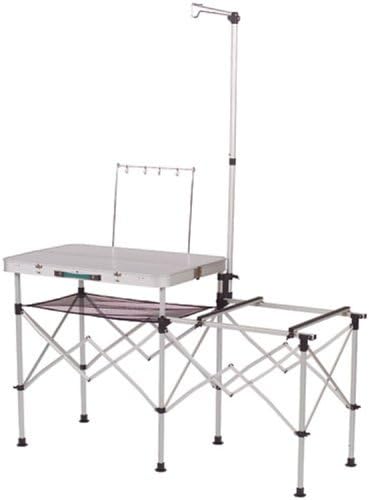
Coleman’s own folding kitchen is built around its stoves and coolers, with a side table sized for them plus a lantern holder, hanging hooks and a mesh shelf.
When a Plain Folding Table Is Enough
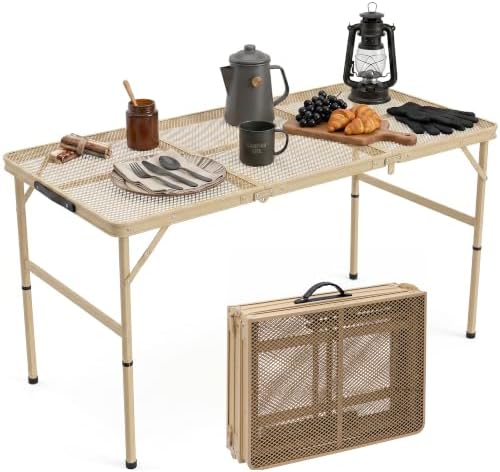
If you cook simply and the site usually has a decent picnic table, a sturdy folding camp table with adjustable legs costs far less and packs smaller. It gives you the height and the second surface without the shelves.
Formats Compared
Four formats cover the shelf, and they differ mostly in how much of the camp kitchen they absorb.
| Format | What it replaces | Setup | Packed size |
|---|---|---|---|
| Full cook station | The whole cooking half of the site | One piece, folds up in seconds | Large, tall when folded |
| Station with sink | Cooking plus washing up | Sink adds a fill and drain step | Large |
| Brand matched kitchen | Stove and cooler placement | Frame plus countertop | Moderate |
| Plain folding table | Prep height only | Fastest, legs and go | Smallest, packs flat |
Wind, Level Ground and Placement
A camp kitchen table with a stove on it needs level ground more than any other piece of furniture at the site. Look for adjustable feet or a frame you can shim, and set it up before you load it rather than trying to level a table carrying a full stove.
Place the kitchen downwind of the sleeping area so cooking smells and smoke drift away from the tents, and off the main walking route so nobody passes between the cook and the hot surface. If the site is exposed, put the kitchen where a vehicle or a solid object breaks the prevailing wind rather than relying on stove guards alone.
Wind Screens Around the Stove
Some cook stations include or accept a wind screen around the stove position. Where one is offered, check that the maker intends it for use with a stove and follow the clearance the stove manual specifies. An improvised screen too close to a burner is worse than no screen at all.
Using a Stove on a Camp Kitchen Table
Camp stoves and grills are outdoor appliances. Coleman, Camp Chef and other manufacturers state in their manuals that these units are for outdoor use only and must never be operated inside a tent, an awning, a screen room, a vehicle or any enclosed space, because burning fuel produces carbon monoxide.
Use the clearance distances the stove manual gives from surfaces and overhead objects, rather than assuming a heat resistant tabletop removes the requirement. Keep hoses and cylinders out of the walking lane, and carry a battery powered carbon monoxide alarm for the sleeping area as a matter of course.
Frequently Asked Questions
Do I need a camp kitchen table if the site has a picnic table? Not strictly, but it moves the stove off the eating surface and raises the cooking height, which is the single biggest comfort upgrade in a camp kitchen.
Can I put a camp stove directly on the tabletop? Only where the manufacturer says the surface is intended for it, and only with the clearance your stove manual requires. Check both statements rather than one.
How much weight can a camp kitchen table hold? It varies by model and the maker usually publishes it. GCI lists the Slim-Fold Cook Station main surface at up to 48 pounds with side tables at 30 pounds each.
Is a camp kitchen with a sink worth it? If your sites lack a spigot near the table, yes, because it contains dish water instead of letting it run onto the ground. Empty greywater where the campground directs, not into the brush.
Will a camp kitchen table fit in a sedan trunk? Full cook stations are tall when folded and often need the back seat down. Measure the packed dimensions against your car before ordering.
What is the difference between a camp kitchen and a chuck box? A camp kitchen is a surface you cook on; a chuck box is a container that carries and organizes the kitchen. Many campers end up with both.
The Bottom Line
A camp kitchen table earns its trunk space by giving the stove somewhere to live that is not the picnic table. Buy for the published surface rating, real side shelves and feet you can level, and check the packed size before anything else. If you want the kitchen to travel packed rather than assembled, our chuck box guide covers buying versus building one, and the camp sink and dish setup guide handles the washing up half.