Last updated: August 20, 2026
An air mattress is the most popular first upgrade in car camping and the one that most often disappoints, usually for a reason nobody warned the buyer about. The mattress is not leaking and it is not badly made. It is simply doing what a large volume of trapped air does when the tent cools after dark, and the result is a bed that feels firm at bedtime and cold and soft at five in the morning.
This guide covers what actually makes a camping air mattress work over cold ground: construction that resists ground abrasion, a pump you can run without a wall outlet, height that suits your tent rather than your bedroom, and the insulating layer that turns it from a raft of cold air into an actual bed. It also covers how to tell a real leak from ordinary overnight cooling.
This article contains affiliate links. If you buy through them, we may earn a commission at no extra cost to you. Learn more.
Quick Answer
What makes a camping air mattress survive cold ground?
- A layer on top, foam or a self inflating pad, because the air inside cools to tent temperature.
- A tough underside and a footprint or tarp between the mattress and the tent floor.
- A pump that works off batteries or a rechargeable cell, not only a household outlet.
- Height and size chosen for your tent floor, not for how it looks in a bedroom.
Bottom line: buy for durable construction and a self contained pump, then add an insulating layer on top before you judge how warm it sleeps.
Why Air Mattresses Sleep Cold
The air inside a mattress settles to roughly the temperature of the tent, and it does not stay still. Body heat warms the air nearest you, that warmer air rises, cooler air drops toward the floor, and the loop repeats all night, carrying heat downward. The vinyl shell contributes almost nothing as insulation.
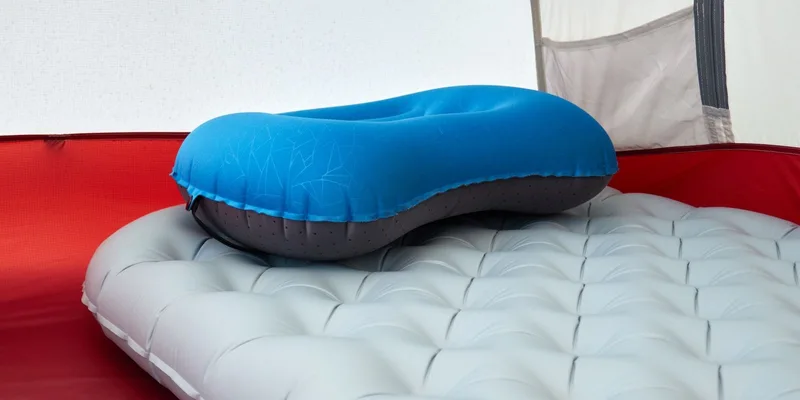
Putting a blanket or foam under the mattress protects it from the ground but does little for warmth, because the air inside still equalizes with the tent. The layer that works goes on top, between you and the mattress surface, which is exactly the job a sleeping pad is built for.
Construction: What Holds Up at a Campground
Camping specific mattresses differ from guest room models in the shell material and the seam construction. Look for a thicker, textured underside meant for ground contact, welded seams rather than glued ones, and an internal structure of coils or beams that keeps the top surface flat instead of ballooning into a dome.
Flocked tops feel warmer against skin and keep a sleeping bag from sliding, and internal coil construction spreads weight more evenly than open chamber designs. Coleman is the most widely stocked brand in this category on Amazon, with a range of camping oriented models that separate the outdoor line from indoor guest beds.
Protect the Underside
Most punctures happen from below, from a twig or a stone pressed against the vinyl by your own weight. A cheap tarp or a tent footprint under the mattress is the single most effective thing you can do to extend its life, and it costs almost nothing.
Clear the tent floor before you inflate, not after. Once the mattress is inflated it covers everything, and you will find the sharp object with your hip at midnight rather than with your hand at setup.
Pumps: The Part People Forget
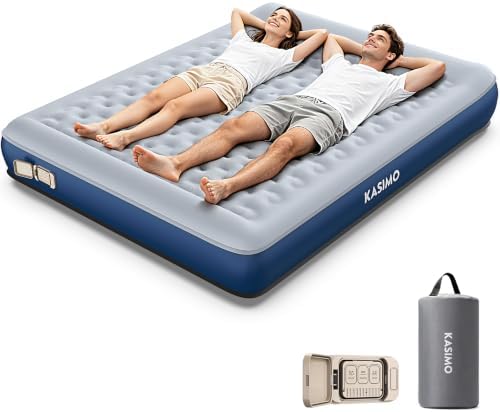
A built in pump is convenient right up to the moment you realize it needs household power. At a campground without electric hookups, that means either a rechargeable pump, a battery pump, a pump that runs from the vehicle’s accessory socket, or a manual foot or hand pump as backup.
Rechargeable pumps have become the default for car camping because one charge typically covers inflating and deflating over a weekend. Whichever you choose, take a manual pump as backup, since it is small, it never runs out of charge, and it also handles the evening top up.

Size and Height for a Tent, Not a Bedroom
Household mattress sizes describe the mattress, not the space you need around it. In a tent you also need room to step past the bed, room for the door to zip without catching, and clearance so the sides do not press against the inner wall where condensation collects.
Height is a genuine tradeoff. A tall double high mattress is easy to get onto and eats headroom in a low tent, while a lower single height model leaves more usable space and sits closer to the cold floor. For a full walkthrough of floor measurements, see our guide to a queen air mattress for camping.
Choosing by Situation
| Type | Height | Best for | Watch out for |
|---|---|---|---|
| Single height, coil | Low | Low tents, cold nights | Harder to get up from |
| Double high | Tall | Easy entry, guest use too | Headroom and more air to cool |
| Self inflating hybrid | Low | Warmth without a pump | Firmer, less contour |
| Vehicle specific | Low | Sleeping in an SUV | Shaped to a specific bay |
Best for a family tent shared with kids
A wide, single height mattress puts the sleeping surface close to the floor, which is easier for children to climb onto and leaves more headroom for anyone standing to change.

Best insulating layer to add on top
A self inflating pad laid over the mattress is what closes the warmth gap, and it doubles as the backup bed if the mattress ever gives up mid trip.

Real Leak or Just Cold Air
A mattress that feels softer at dawn than at bedtime is usually showing normal thermal contraction, not a puncture. The test is simple: inflate it fully indoors at a stable temperature and leave it two days. If it holds, the overnight softening at camp was the temperature drop.
If it genuinely leaks, find the hole with soapy water on the inflated surface and repair it with the kit that came with the mattress or a vinyl repair patch. Most punctures are on the underside, which is another argument for that tarp.
Frequently Asked Questions
Why is my air mattress cold when camping? The air inside cools to tent temperature and convects, carrying your body heat toward the ground. A foam or self inflating pad on top of the mattress is the fix, not a blanket underneath it.
Does putting a blanket under the air mattress help? It protects the vinyl from the ground, which is worth doing, but it does little for warmth because the air inside still equalizes with the tent.
Why does my air mattress go soft overnight? Usually cooling air contracting rather than a leak. Test it indoors at a steady temperature for two days before assuming a puncture.
What pump should I take if there is no power at the site? A rechargeable or battery pump, with a manual foot pump as backup for top ups and for the trip when you forgot to charge anything.
Can I use a regular household air mattress for camping? You can, but the shell and seams are built for a carpeted guest room rather than ground contact. Camping specific models use tougher undersides.
Should I get a cot instead? If your sites are rough or wet, possibly. Both need a pad on top, and our cot versus air mattress comparison works through the tradeoffs.
The Bottom Line
Buy a camping air mattress for its construction and its pump, not for its height, then treat the insulating layer on top as part of the purchase rather than an optional extra. Put a tarp underneath, clear the floor before inflating, and expect an evening top up as normal rather than a defect. For sizing against a specific tent, read our queen air mattress guide, and for sleeping in the vehicle instead, see air mattress for car camping.