Last updated: August 20, 2026
Plenty of campgrounds provide a picnic table, and plenty of the ones that do provide a table with a wobble, a slope, and a surface that has been rained on since spring. Dispersed sites usually provide nothing at all. Either way, the table you bring is what decides whether the stove has a level home and whether dinner gets prepped standing up or crouched over a cooler lid.
Camp tables split cleanly by tabletop construction: rolled aluminum slats, rigid plastic panels and blow molded plastic tops. Each one behaves differently on wind, spills and heat, and each one packs differently in the car. This guide covers those differences and how to match a top to the way you cook and eat at a site.
This article contains affiliate links. If you buy through them, we may earn a commission at no extra cost to you. Learn more.
Quick Answer
Which camping table should you buy?
- Roll top aluminum packs smallest and drains spills through the slats, so it suits prep more than card games.
- Blow molded plastic gives a solid flat surface that wipes clean and takes the most weight.
- Slatted plastic and hard panel tops sit between the two on both counts.
- Height adjustment matters if the table doubles as a stove stand and a dining surface.
Bottom line: pick the tabletop for what you put on it, then check folded size against the space left in the car.
The Three Tabletop Types
Roll top tables use aluminum slats joined on a fabric or cord backing that rolls up around an X frame. Hard panel tables use one or two rigid sections that fold flat. Blow molded tables use a thick hollow plastic top on a steel frame, the same construction used for household folding tables.
Everything else follows from that choice. Roll tops win on pack size, blow molded tops win on stability and surface quality, and hard panel tables land in between while usually being the quickest to open.
What Each Top Does With Spills, Wind and Heat
A roll top drains liquid straight through the gaps, which is helpful for rinsing vegetables and unhelpful under a card game or a plate of small items. A solid top holds spills on the surface until you wipe them, which is the better behavior at dinner and the worse one when someone knocks over a drink.
Wind treats them differently too. A slatted top lets gusts pass through, while a solid top wants to lift if the table is light and the wind is strong. Neither top is a heat resistant surface, so a hot pan or a stove goes on a trivet or a dedicated stove stand rather than straight onto the table.
Cleaning and Sand
Slats collect grit in every gap, which matters more at the beach than in a forest. A solid top wipes down in one pass and packs away clean, and that difference shows up quickly on a coastal trip where everything ends up sandy.
Height, Weight Capacity and Stability
Look for published height settings rather than a single number. ALPS Mountaineering lists its Overlanding table with three height settings of 29, 31 and 36 inches, which covers sitting at a chair and standing to cook. A table stuck at one height forces the rest of the kitchen to fit around it.
Capacity varies enormously between models and even within a brand, so use the figure in the listing for the exact table you are buying. Lifetime, for example, publishes different maximum weights across its consumer fold in half tables and its commercial line, and the gap between them is large.
Camping Tables by Situation
Match the table to its main job. A prep table beside the stove has different priorities from a dining table for four, and a table that mostly holds a lantern and two mugs needs neither.
Best Compact Roll Top for Prep
An aluminum roll top on an X frame packs into a shoulder bag and gives you a stable working surface beside the stove.

Best Solid Top for Family Meals
A blow molded folding table gives a flat wipe clean surface with room for plates, and the frames are built for repeated use.

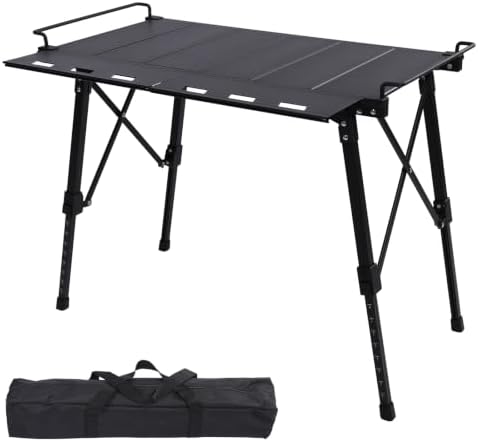
Best Adjustable Height Table
Tables with two or three published height settings work as a stove stand while cooking and a dining surface afterwards.
Best Small Table for a Tight Site
A compact side table takes a lantern, drinks and a phone without eating into the walking space on a small pad.

Best Table With Storage Underneath
Tables with a shelf or hanging organizer keep utensils and bottles off the ground and out of the dirt.

Comparing Tabletop Types
The table below is the short version of the decision. Read the last column against how you actually camp, since surface quality and pack size pull in opposite directions.
| Top type | Surface | Packs to | Best for |
|---|---|---|---|
| Roll top aluminum | Slatted, drains spills | Smallest, a bag | Prep beside the stove |
| Blow molded plastic | Solid, wipe clean | Flat and heavy | Meals and games |
| Hard panel fold | Solid, seams visible | Flat, medium | Fast setup, mixed use |
| Slatted plastic | Semi solid | Compact | Side table duty |
Where the Table Goes on the Site
Put the kitchen table downwind of the sleeping area so cooking smells and smoke drift away from the tent, and leave a clear walking lane between the table and the fire ring. On a small pad that usually means the table sits parallel to the car rather than in the middle of the site.
Level ground matters more for a table than for a chair, since a slope shows up in every pot and every drink. Spend a minute finding the flattest patch before unfolding, and pack a couple of thin shims if your usual campground is built on a hillside.
Frequently Asked Questions
Are roll top camping tables sturdy? The good ones are, because the slats tension across an X frame once the top is unrolled. They are less rigid than a solid top under a heavy load, so treat published capacity as the limit rather than a suggestion.
Can you put a camp stove on a folding table? Only where the maker says the table is suitable for it, and never with a hot base directly on the surface. Many campers use a dedicated stove stand or a heat resistant mat and keep the table for prep and plates.
What height should a camping table be? Around normal table height for eating and higher for standing prep. Tables with published height settings, such as the 29, 31 and 36 inch options ALPS lists on its Overlanding table, cover both without compromise.
How much weight can a camping table hold? It depends on the model, and the range within one brand can be very wide. Check the maximum weight published on the listing for the exact table rather than assuming a category figure.
Do camping tables blow over in wind? A light table with a solid top can. Weight it down with a full water jug or the cooler, and choose a slatted top if you regularly camp somewhere exposed.
Is a camp table worth it if the site has a picnic table? Often yes, because a second surface separates prep from eating, and campground tables are frequently uneven or too far from where you want to cook.
The Bottom Line
Choose the top for the job: slats for prep and pack size, a solid surface for meals and cards. Then check the published height settings and capacity for the exact model, and measure the folded size against what is left in the car. For the mechanism and wobble questions, see our guide to folding camp tables, and for a dedicated cooking setup look at the camp kitchen table.